
Switzerland · Grimsel
Sagittarius
A Grimsel granite classic: low-angle slabs lead to the famous 6a+ crack pitches and a thin 6b traverse, then steeper, sculpted ground. Sustained at 5c/6a throughout.
6b13 pitches400 m
Räterichsbodensee – Seeplatten · Grimsel · Switzerland
Read the cautionsEasy to bailBolting confidence: medium
Glacier-polished slabs straight above the Räterichsboden dam. Four warm-up pitches lead to sustained 5b–5c slab and a short fissured roof (6a or A0).
Fully bolted and reopened, but it lies in the 2022/2023 Seeplatten rockfall zone, was only partially refurbished in 2024 and still has rubble on the ledges.
The route
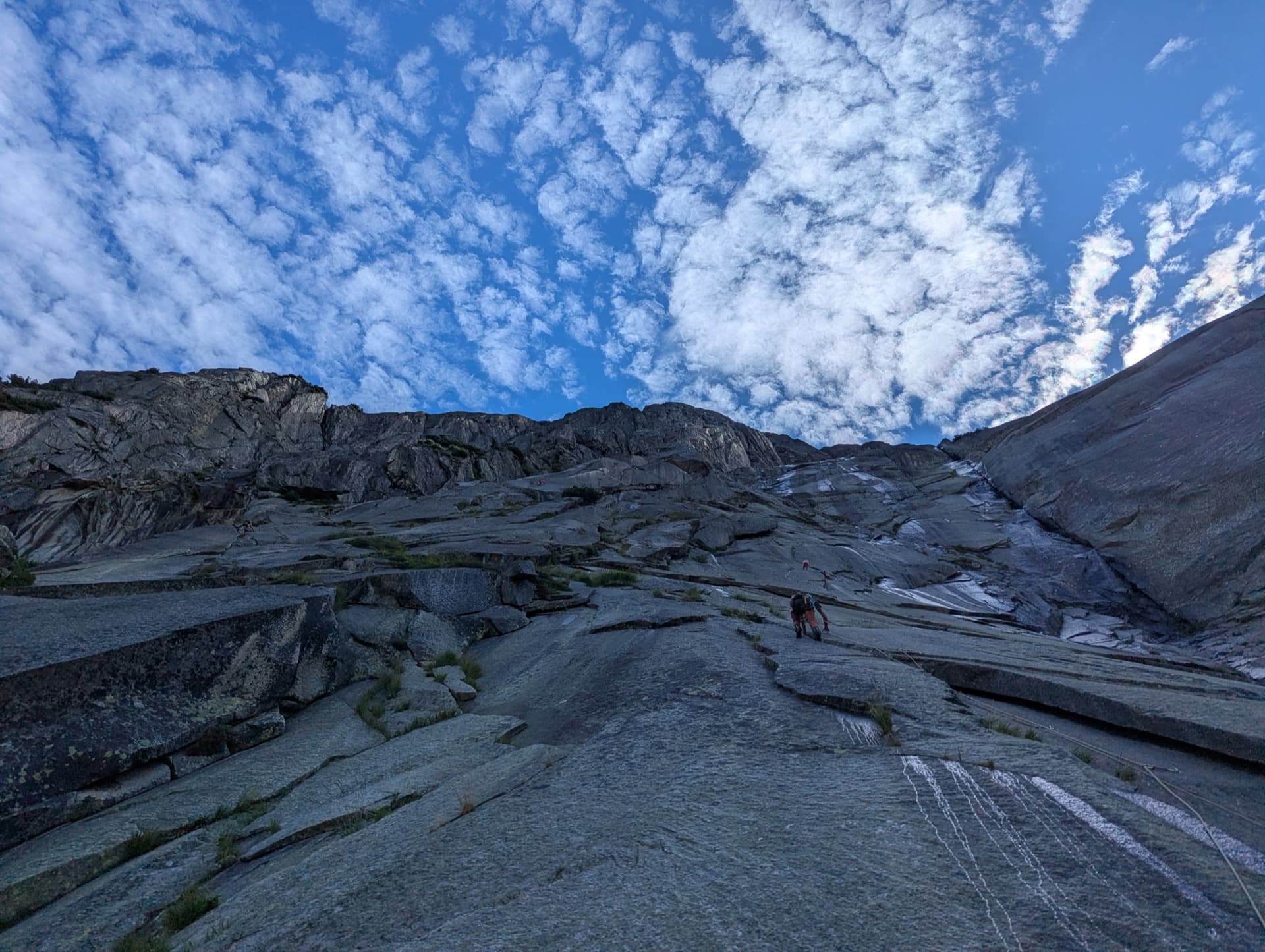
Grimselstrom is an 11-pitch friction route on the glacier-polished Seeplatten slabs directly above the Räterichsbodensee reservoir on the Grimsel pass road. Four easy pitches (4b to 5a) lead to sustained 5b/5c slab, a small cracked overhang, and a short cracked roof that goes at 6a or with one pull on a bolt. The bolts are stainless and sound but spaced in the slab style, so the 5c moves between them are obligatory. The sector was hit by rockfalls in June 2022 and June 2023; the route was partly re-equipped and reopened in September 2024, and rubble still lies on the ledges.
In pictures
The climbing
| Pitch | Grade | Length | Bolts | Notes |
|---|---|---|---|---|
| P1 | 4c | 27 m | 6 bolts | Approach slab. Belay on three hangers. |
| P2 | 5a | 23 m | 4 bolts | Links well with pitch 1. |
| P3 | 4c | 35 m | 6 bolts | Easy slab. |
| P4 | 4b | 45 m | 5 bolts | Long easy slab; last of the approach pitches. |
| P5 | 5b | 38 m | 9 bolts | It steepens a little, still with holds. |
| P6 | 5c | 36 m | 7 bolts | Straight up, then a detour right that touches the old-hanger route, then straight up again. Few holds, sustained friction. |
| P7 | 5c | 30 m | 7 bolts | More of the same. |
| P8 | 5b | 20 m | 6 bolts | A small cracked overhang; reported as easy and closely bolted. |
| P9 | 5a | – | – | A very pretty glacier-polished slab. |
| P10 | 6a | – | – | Short cracked roof: 6a for one move, or A0. |
| P11 | 5c | – | – | Short finishing pitch. |
Getting there
Park at the Räterichsbodensee dam (1767 m) on the Grimsel pass road, reached from Innertkirchen and Guttannen on the Bernese side or over the pass from the Valais. The road is open from about late May or June to October/November. A postbus runs June to October. Accommodation at Hotel Handegg, the Grimsel hospice or in Innertkirchen.
15-20 min. From the parking go up onto the dam and cross it. At the far end turn left on the big path cut across the Seeplatten slabs; the routes start from the path. Grimselstrom starts on a small reclining pillar, 10 m right of Neuholz (name painted at its base) and 20 m left of Tim und Struppi ('TIM' painted at its base). An older route on old hangers starts between the two; do not take it.
Loading map
The point marks the base of the route.
Parking
Räterichsbodensee (camptocamp access point)
Point from camptocamp route 561804
Contains the route point and parking. Opens in most mapping apps and GPS watches.
Points are compiled from published sources, with the precision stated above. They were not surveyed on the ground: check them against a current topo.
Coordinates: 46.58319, 8.32358 (route base) · Parking: 46.59062, 8.32794
Getting down
Abseil the route on equipped anchors. From R8 abseil directly to R6, and from R2 directly to the path. On the camptocamp figures pitches 1 and 2 total 50 m, so the last abseil uses the full length of 50 m ropes. Filidor warns specifically to take care when abseiling because of rubble on the ledges.
Retreat
Easy to bail
Yes. The normal descent is to abseil the route on equipped anchors, so you can turn round at any belay. The caveat is rubble left on the ledges by the 2022 and 2023 rockfalls: Filidor asks for particular care when abseiling, and anything you or your ropes dislodge goes down the line.
Partly inferred from the route facts
Safety
Sun and weather
East facing at 1770-2010 m: morning sun, shade in the afternoon (a mid-October party climbed in the sun and abseiled in the shade). Season is roughly June to October while the pass road is open. Pure friction climbing, so it needs dry rock; Gulliver warns that lichen on the slab is treacherous.
Sun on the wall · E-facing
Working out the sunlit hours for this month.
Sun on the wallDaylight, wall in shade● Usual season
Estimated from the wall's aspect only. Ignores surrounding terrain, gullies and the wall's exact shape. Clock times are local to the wall (Central European time), for the 15th of each month.
| Measure | Jan | Feb | Mar | Apr | May | Jun (usual season) | Jul (usual season) | Aug (usual season) | Sep (usual season) | Oct | Nov | Dec |
|---|---|---|---|---|---|---|---|---|---|---|---|---|
| Mean daily high °C | −3 | −1 | 2 | 5 | 9 | 14 | 17 | 17 | 13 | 8 | 2 | −2 |
| Mean daily low °C | −8 | −8 | −5 | −2 | 2 | 6 | 8 | 9 | 5 | 1 | −4 | −8 |
| Rain days 1 mm or more | 14 | 12 | 15 | 15 | 18 | 19 | 20 | 18 | 15 | 14 | 15 | 15 |
● marks the usual climbing season. Averages for 1991-2020 at about 1777 m. Area climate from Open-Meteo reanalysis. Temperatures are adjusted to the height of the crag; rain comes from a grid cell of about 10 to 25 km, and summer highs on sea cliffs can read a few degrees low. The wall and valley can differ. Data: Open-Meteo, CC BY 4.0.
What to carry
2×50 m ropes. Camptocamp lists 10 quickdraws and Gulliver 12; pitch 5 has 9 bolts, so 12 is the safer number. Helmet, essential here given the rockfall history.
Derived from the route data; check it against a current topo
From climbers
Reader reports are not being collected yet. Until they are, check a current topo and the local club or guidebook publisher for recent changes to Grimselstrom.
Worth knowing
Open questions
Provenance
Same area
Switzerland · Grimsel
A Grimsel granite classic: low-angle slabs lead to the famous 6a+ crack pitches and a thin 6b traverse, then steeper, sculpted ground. Sustained at 5c/6a throughout.
6b13 pitches400 m
Switzerland · Grimsel
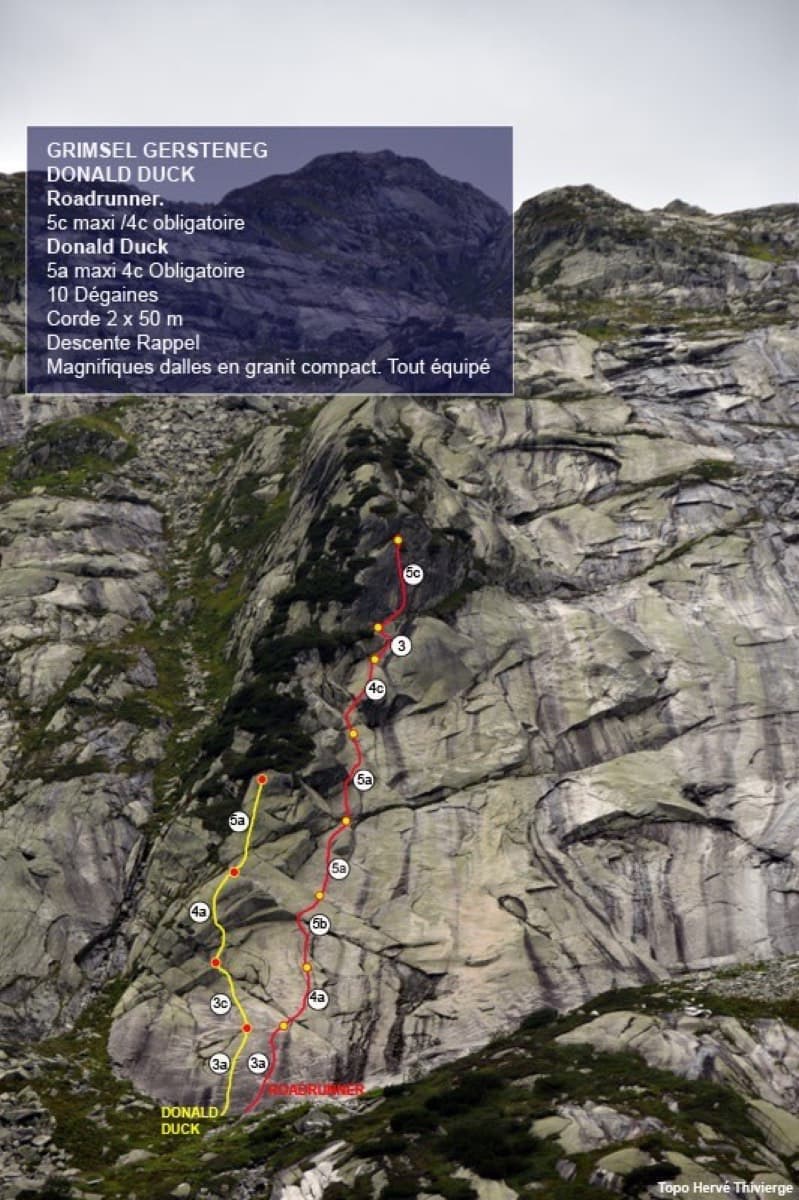
Seven pitches of smooth, low-angle Grimsel granite, almost all pure friction, with two short steeper steps. Technically easy, but you have to trust your feet. A gentle introduction to Grimsel slab and to multipitch rope work.
4c7 pitches200 m
Switzerland · Grimsel
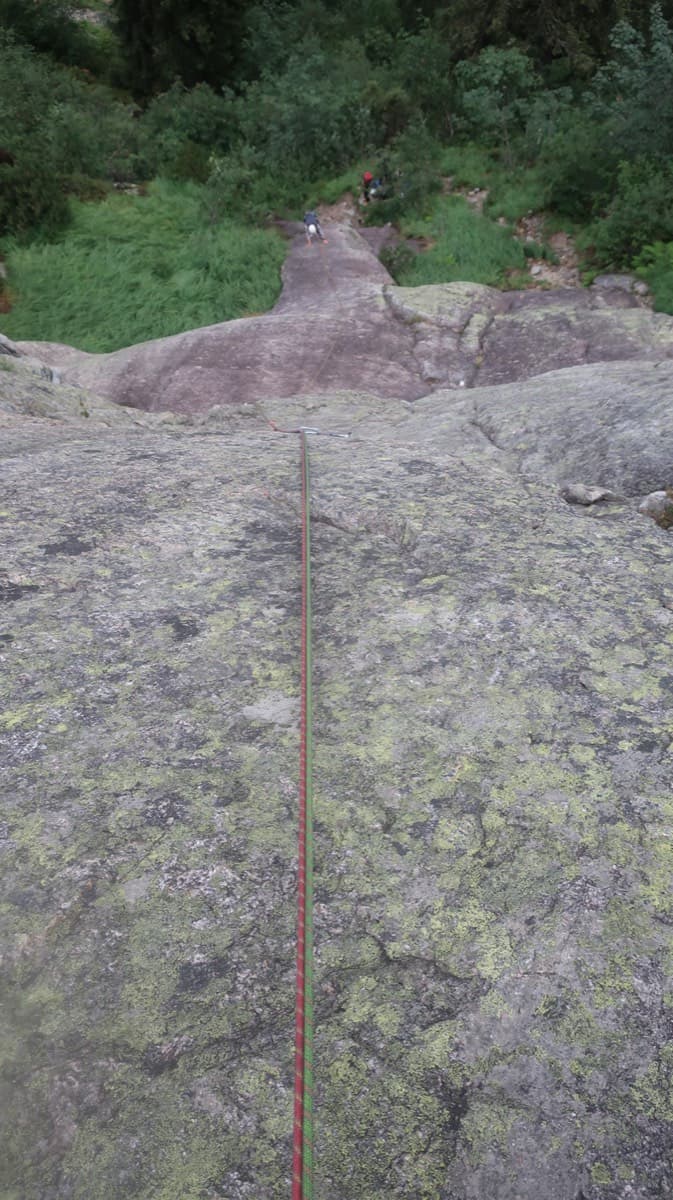
A short, varied granite route up a pale, smooth pillar across the valley from the Handegg slabs: a corner crack, then friction and edge slabs that get harder pitch by pitch. Grades are stiff, and the last pitch is sustained and tricky. A good half day or uncertain-weather route with a 15-minute approach.
6a5 pitches200 m
Switzerland · Grimsel
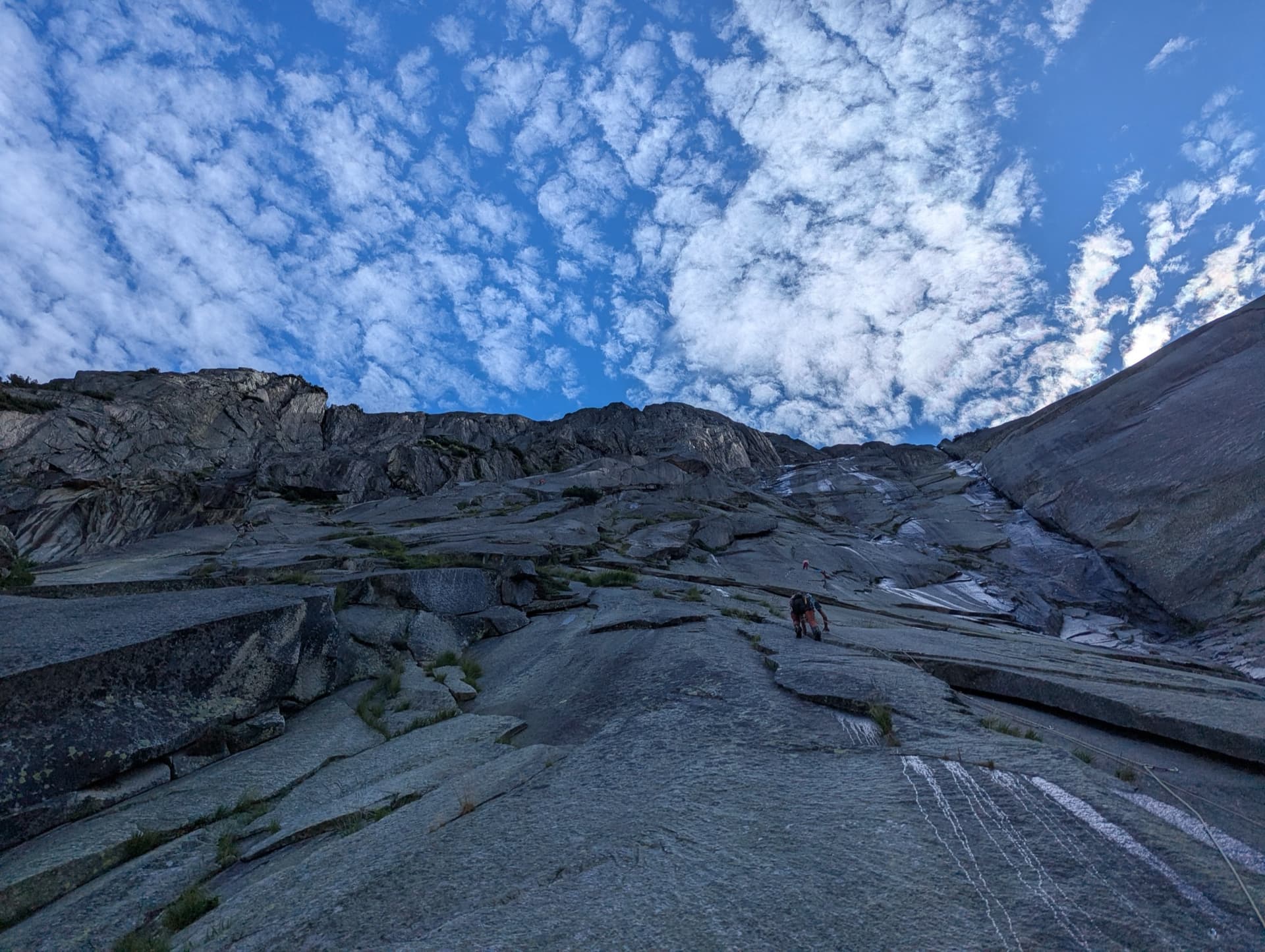
Fourteen pitches up the Gelmerfluh next to Sagittarius, and by several accounts the better route: a knife-cut flake, a finger-to-hand crack worthy of Chamonix, corners, a pendulum and Grimsel slab, then easier quartz-veined walls to the top. Mostly 5c to 6a, with two short slab cruxes that almost everyone aids.
6c+14 pitches400 m
Around 6a · about 11 pitches
Greece · Kalymnos & Telendos
The first route on the wall (Odermatt and Keller, 2008), climbing a long, exposed line on sharp, grippy rock right of the huge roof. The lower pitches are easy for the grade. The two 6a cruxes are a short odd corner over a small roof and a traverse high up, and they come with big exposure. Pitches are short, so you can link them with long draws.
6a11 pitches250 m
Switzerland · Ticino
Slab pitches give way to a vertical wall threaded with quartz veins, which gives the route its name. It is shady in the morning, and the pitches are short (about 35 m), so 11 go quickly.
6a11 pitches400 m
Italy · Aosta Valley
This is the most-climbed route on the Paretone. It gives sustained, varied slab and crack climbing on good gneiss, and the hardest moves are a fine crack on P2, a slanting corner and a punchy wall. Queues are common on good days. The Mani Nude guidebook grades it stiffly; camptocamp's Italian page calls it sustained at 5b–5c+ with a single 6a.
6a10 pitches290 m
Read the cautions
Italy · Val d'Ossola
Twelve long pitches of sunny gneiss slab above Oira, mostly 4c to 5b+ with two 6a pitches: a thin slab at the start and an athletic corner on pitch 10. Pitches are up to 55 m. A winter-sun route with a summit book and plaques at both ends.
6a12 pitches530 m
Compiled from published sources and last verified October 2026. Bolts, anchors and access change. Climbing is dangerous and you are responsible for your own decisions: check a current topo and read the disclaimer.