.jpg)
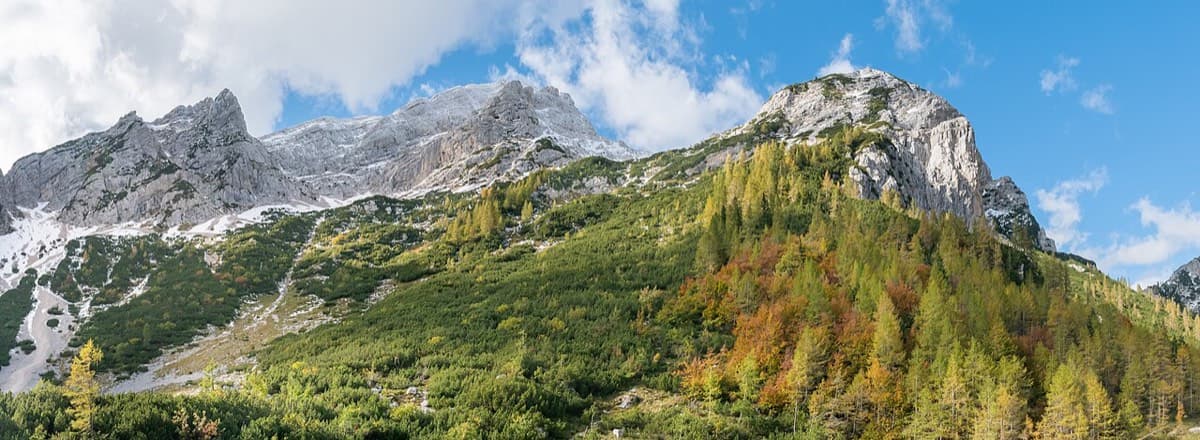
Slovenia · Vršič Pass (Julian Alps)
Mandolinca
A compact modern sport multipitch by Tomo and Dragica Česen, front-loaded with its longest and hardest pitch. It is close to the road and good for a half-day.
6b4 pitches90 m
Nad Šitom glava – SE face · Vršič Pass (Julian Alps) · Slovenia
Read the cautionsEasy to bailBolting confidence: high
Sustained slab climbing up a striking black streak, clearly visible from the pass, on surprisingly good rock for this face. The crux is a move from slab into a corner on P2.
Fully bolted and safe by all accounts, but the crux is 6b+/6c free rather than 6b; the first ascensionist confirms it goes at 6a A0.
The route
A short, steep four-pitch sport route up the obvious black streak on the south-east face of Nad Šitom glava, visible from the Vršič pass. The climbing is sustained slab and corner work on compact rock, and it is the hardest of the modern bolted lines on this part of the wall. The first ascensionist gave the crux pitch 6b, but every repeat report found says it is harder, nearer 6b+ or 6c. The crux and the hard start of pitch 3 can both be pulled through on the bolts, with 6a obligatory. Bolting is complete and repeaters call it safe, so the seriousness comes from the grade rather than the gear.
The climbing
| Pitch | Grade | Length | Bolts | Notes |
|---|---|---|---|---|
| P1 | 6a | 28 m | 7 bolts | Start up a crack through slabs to a small ledge. Move right onto the slabs, then straight up to the belay. |
| P2 | 6b+ | 25 m | 9 bolts | Right from the belay and straight up the slabs, then traverse left to the edge of the black streak and follow a small corner to the belay. The step from the slab into the corner is the crux of the route. Graded 6b by the first ascensionist and 6b+ to 6c by repeaters; it can be aided on the bolts (A0). |
| P3 | 6a+ | 25 m | 7 bolts | Follow a crack left, then go right to below a smooth corner. Getting into the corner is hard and can be aided (A0). Higher up the corner opens out and the rock improves. Good stance below the exit pitch. |
| P4 | 5b | 27 m | 5 bolts | Climb a wide chimney until you can reach the slabs on the left. Cross them leftwards to the arete and follow it to the top of the route on the rim of the wall, where there is a comfortable bolted belay and abseil station. |
Getting there
The face stands directly above the Vršič pass road in the Julian Alps; Kranjska Gora is the nearest town. Park at the pass. Sources describe the scree as running straight from the Vršič car park to the foot of the wall. None of the sources read gives bus or parking-fee details.
From the Vršič pass go up the scree towards the south-east face, then follow the foot of the wall rightwards. Neighbouring routes in this sector are given 25–30 min from the pass. The start is about 50 m right of the route Stoletje, just right of a small cave, where you can see the first bolt. Mavrica življenja starts about 20 m to the left and Rdeča pentlja about 15 m to the left. No source mentions a name painted at the base.
Loading map
The point marks the crag, not the exact start of the route.
Point from plezanje.net crag "Nad Šitom glava, jugovzhodna stena"
Contains the route point. Opens in most mapping apps and GPS watches.
Points are compiled from published sources, with the precision stated above. They were not surveyed on the ground: check them against a current topo.
Coordinates: 46.43890, 13.73931 (crag)
Getting down
Abseil the line of the route. The abseils are equipped along the route and are about 25 m each, so a single 60 m rope is enough. The top station is at the comfortable belay on the rim of the wall.
Retreat
Easy to bail
Yes. The route is abseiled as its normal descent, with bolted abseil anchors along the line and abseils of about 25 m. A single 60 m rope gets you down from any belay.
Partly inferred from the route facts
Safety
Sun and weather
South-east facing, with route altitudes on plezanje.net between about 1,850 and 2,000 m. One area guide notes the face goes into shade after about 14:00, so summer afternoons are cool and spring or autumn give more sun. plezanje.net ascent logs for the face cluster in June to September, with a few in May and October. Drying times are not documented.
Sun on the wall · SE-facing
Working out the sunlit hours for this month.
Sun on the wallDaylight, wall in shade● Usual season
Estimated from the wall's aspect only. Ignores surrounding terrain, gullies and the wall's exact shape. Clock times are local to the wall (Central European time), for the 15th of each month.
| Measure | Jan | Feb | Mar | Apr | May | Jun (usual season) | Jul (usual season) | Aug (usual season) | Sep (usual season) | Oct (usual season) | Nov | Dec |
|---|---|---|---|---|---|---|---|---|---|---|---|---|
| Mean daily high °C | −5 | −4 | −0 | 4 | 9 | 13 | 15 | 15 | 11 | 6 | 1 | −4 |
| Mean daily low °C | −11 | −11 | −8 | −4 | 0 | 4 | 6 | 6 | 3 | −1 | −5 | −10 |
| Rain days 1 mm or more | 8 | 9 | 11 | 15 | 18 | 18 | 18 | 17 | 13 | 11 | 12 | 9 |
| Sunshine hours a day | 5.9 | 6.9 | 8.3 | 9.7 | 10.7 | 11.8 | 12.2 | 11.1 | 8.9 | 6.7 | 5.0 | 5.2 |
● marks the usual climbing season. Averages for 1991-2020 at about 2035 m. Area climate from Open-Meteo reanalysis (about 10 km grid): the wall and valley can differ. Data: Open-Meteo, CC BY 4.0.
What to carry
Single 60 m rope, 10 quickdraws. The first ascensionist states that no extra protection is needed. Wear a helmet: he also advised caution because the route was new.
Derived from the route data; check it against a current topo
From climbers
Reader reports are not being collected yet. Until they are, check a current topo and the local club or guidebook publisher for recent changes to Črni panter.
Worth knowing
Open questions
Provenance
Same area
Slovenia · Vršič Pass (Julian Alps)
A compact modern sport multipitch by Tomo and Dragica Česen, front-loaded with its longest and hardest pitch. It is close to the road and good for a half-day.
6b4 pitches90 m
Slovenia · Vršič Pass (Julian Alps)
A memorial route (to Nejc Sedej) of slabs, a little pillar and a final corner-to-pillar pitch that is the crux. 6a is obligatory.
6b4 pitches115 m
Read the cautions
Slovenia · Vršič Pass (Julian Alps)
Beautiful plates and mini dolomite-style runnels, then a final corner. It makes a neat companion to its neighbours on the same face.
6a+4 pitches110 m
Around 6b+ · about 4 pitches
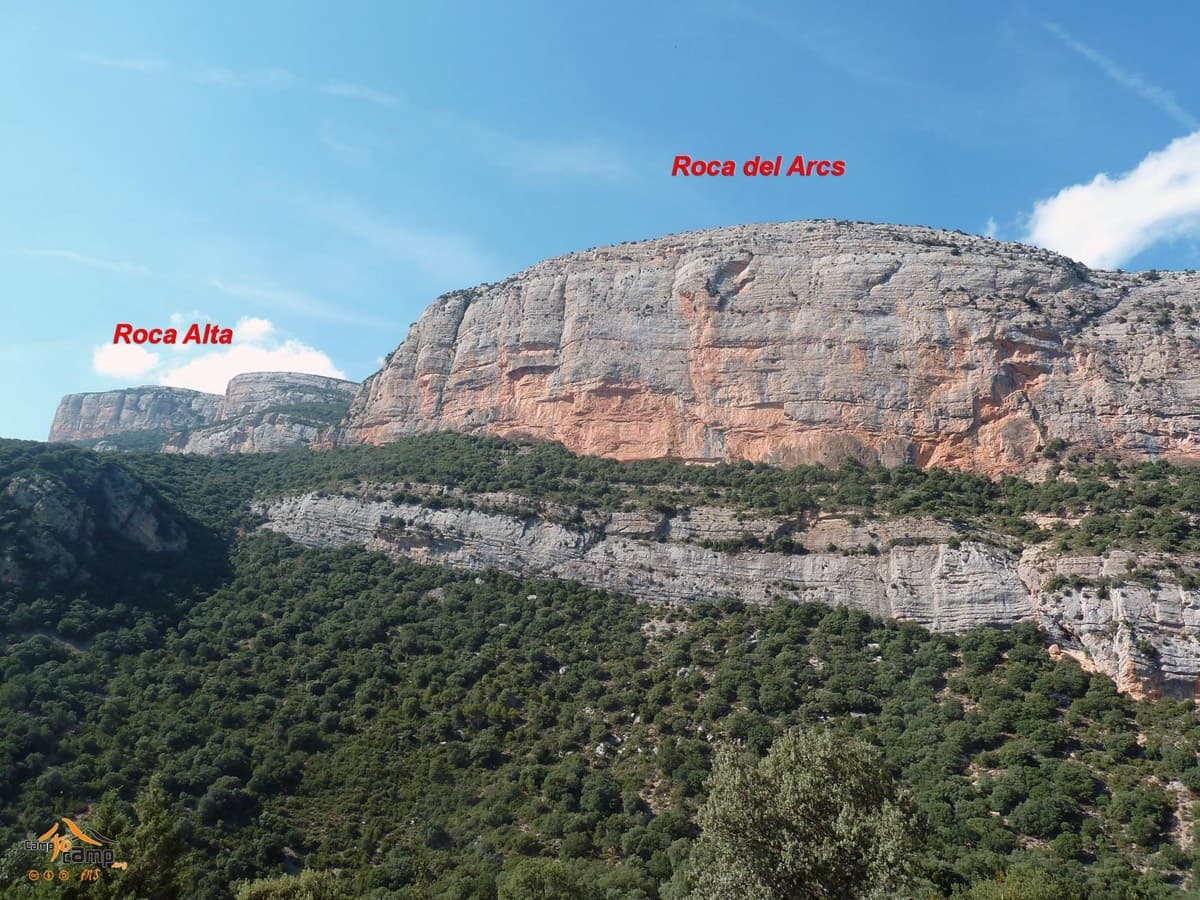
Spain · Vilanova de Meià (Roca dels Arcs)
Four long, steep pitches on the left side of the Roca dels Arcs, sustained at 6a on good holds and not yet polished above the first pitch. The third pitch is the event: a reachy bulge to start, 30 m of gently overhanging strata, and a hard boulder move off a ledge to finish that most people grade 6c. That last move can be avoided by belaying on the neighbouring route.
6b+4 pitches160 m
Austria · Ötztal
A mix of slabs and steep, juggy passages in the Sonnenblume sector, mostly around 5b to 5c+. The one hard move is a small roof on pitch 4 (6b+), which goes easily on aid.
6b+5 pitches170 m
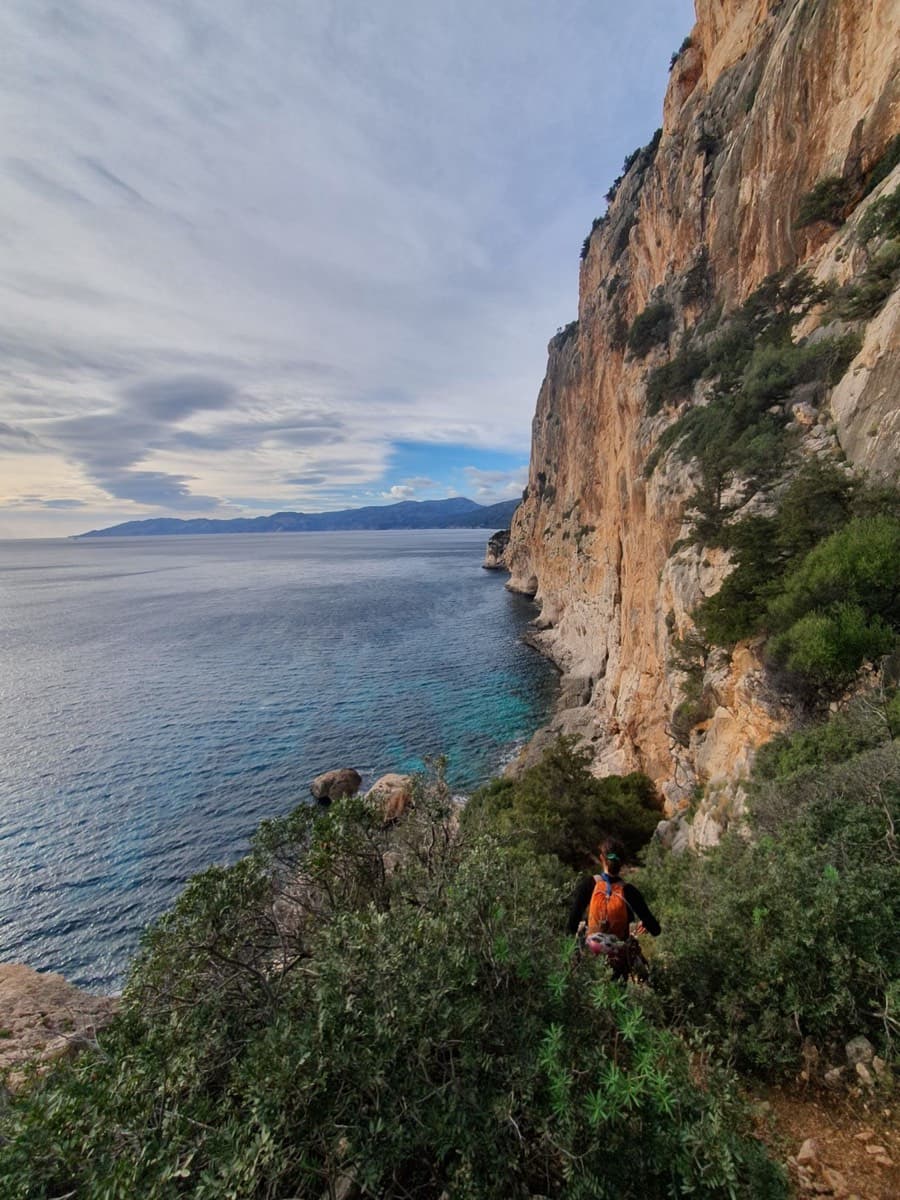
Italy · Sardinia
Five steep, sustained pitches at 6b to 6b+ straight out of the sea on new titanium bolts, on abrasive, pocketed limestone. Bulges, a smooth roof, a corner and a thin finishing crack, with a cave belay after pitch 1.
6b+5 pitches160 m
Austria · Zillertal
A slab route on the left side of the Wiegelwand with steep passages on small edges; UIAA 7/7+ at the crux on pitch 3, 6 to 6+ obligatory. The easier pitches are a bit grassy. Often wet, so look from below first.
6b+5 pitches110 m
Compiled from published sources and last verified October 2026. Bolts, anchors and access change. Climbing is dangerous and you are responsible for your own decisions: check a current topo and read the disclaimer.