Multipitch Atlas

Zulú Demente

La Visera, Mallos de Riglos · Riglos & Agüero (Mallos) · Spain

Read the cautionsCommittingBolting confidence: high

The other great line of the Visera, on a concave wall that leans further out the higher you go. Six pitches at 6a to 6b on big cobbles lead to the vulture ledge, then one short, very overhanging crux pitch above enormous exposure. That last pitch is about 7a free, or roughly 6b to 6c with rests on its closely spaced bolts.

Hand-drawn topo of the Visera at Riglos showing Zulú Demente (right) and Moskitos (left)Photo: Albert Castellet · CC BY-SA 3.0

Topo

Hand-drawn topo of the Visera at Riglos showing Zulú Demente (right) and Moskitos (left)Photo: Albert Castellet · CC BY-SA 3.0
Hardest pitch
7a
Pitches
7
Length
250 m
Approach
15 min
Aspect
S
South-facing
Rope
1×60 m
walk-off
Read before you go

Well bolted where it is hard, but spaced lower down, impossible to retreat from once on the overhanging upper wall, and the crux pitch is 7a or harder if climbed free by the direct start.

The route

Overview

Seven pitches up the south face of the Visera, to the right of La Fiesta de los Bíceps. Everything goes at 6b or easier until the terrace known as the Buitrera, and recent parties find it easier, less busy and less polished than the Fiesta up to that point. The last 25 m pitch is the crux: a hard bouldery start off the ledge, about 15 m of 6b on jugs, then a strenuous exit over the lip. The wall is concave, so it gets steeper as you tire; pace yourself from pitch 3. Bolts are spaced lower down and close together on the crux.

The climbing

Pitch by pitch

Pitches of Zulú Demente
PitchGradeLengthNotes
P16a45 mOver the polished starting bulge (the first bolt is quite high), then immediately diagonally right for the whole pitch, weaving between steps.
P26a+45 mSeveral bulges with sometimes physical mantels to the big terrace where the route crosses Moskitos. The belay is on the left of the ledge.
P36a+35 mStraight up above the belay to an obvious small overhang; the wall starts to lean out here. Slightly hanging belay on three rings. Can be linked with pitch 4 on a 60 m rope if you manage the drag (about 50 m, 6b overall).
P46a+20 mA short half-loop: left first, then back right to a hanging belay about 15 m above the last one. One hard move, the rest on big cobbles.
P56b45 mA long, sustained diagonal leftwards. Do not stop at a poor belay on threads; continue 10 m to the proper one on a step. Take at least 15 quickdraws.
P66b15 mA short pitch with two hard moves and a mantel onto the guano-covered Buitrera ledge, where the real difficulties begin.
P77a25 mThe crux. The original line goes straight up off the ledge on small edges (given 7b or A0 on the first topo); most parties now start slightly left, where the second bolt is awkward to clip. Then about 15 m of 6b on jugs and a final 4 to 5 m over the lip on poorer holds. Bolts are very close, but you still have to climb a little between the last four. A first belay sits just over the lip, a second 10 m higher on the summit terrace.

Getting there

Approach

To the parking

Riglos is about 45 km north-west of Huesca. From Huesca take the A-132 through Ayerbe towards Jaca and turn off to the village; from Pamplona or France come via Puente la Reina de Jaca and the A-132 south. Use the pay car park at the village entrance (3 EUR per day reported in 2025) and walk up through the village.

On foot · about 15 min

About 15 min. From the village take the streets that climb towards the Visera and head for the wall. The start is about 30 m right of Moskitos and is marked 'ZD'. It shares its first metres with Super Crack (recognisable by an extender left on the fourth or fifth bolt): pull over the first steep, polished bulge, then leave Super Crack by going diagonally right. Several parties have followed Super Crack by mistake.

Finding the route · 2 photos

  • OverviewLa Visera with two lines drawn in red: La Fiesta de los Bíceps on the left and Zulú Demente on the right, starting at the right-hand side of the face.Photo: davaz · CC BY-NC-ND 3.0
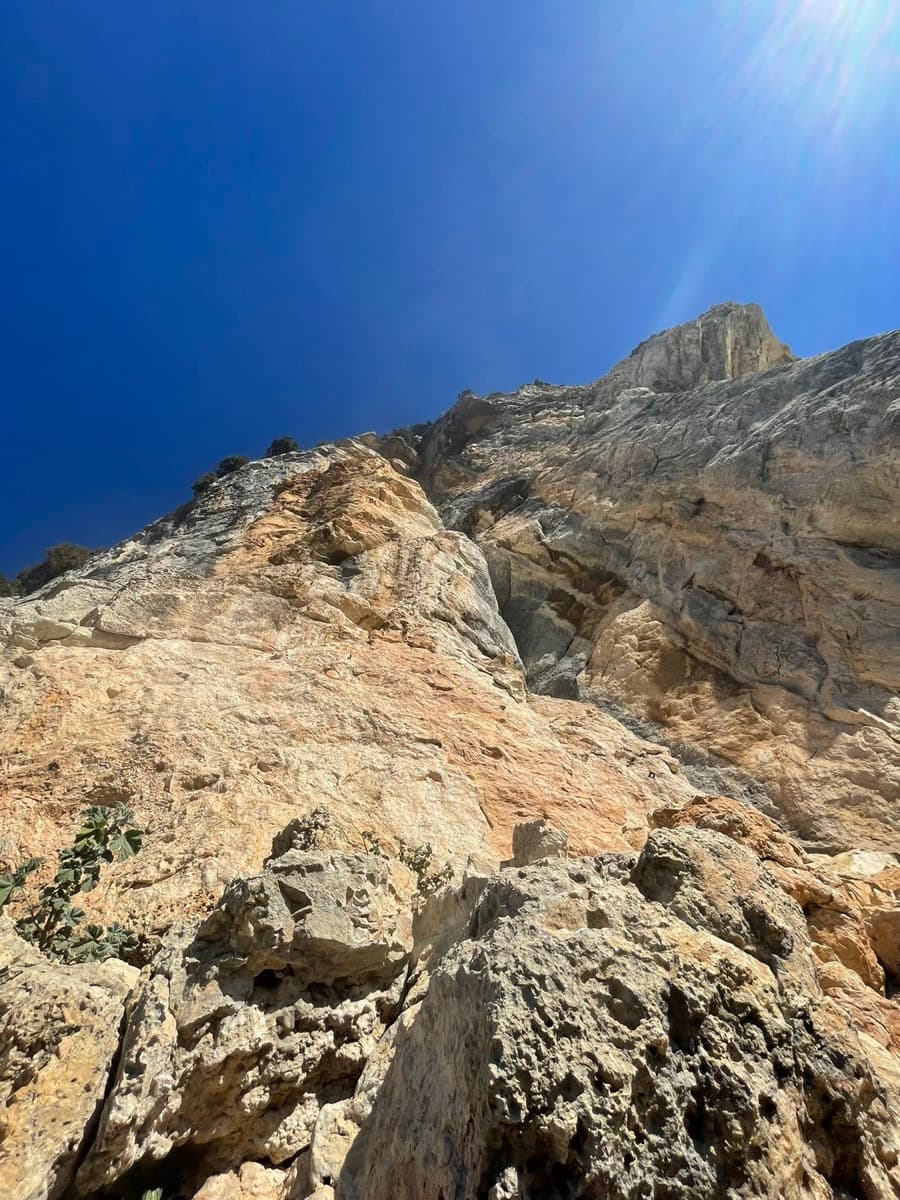
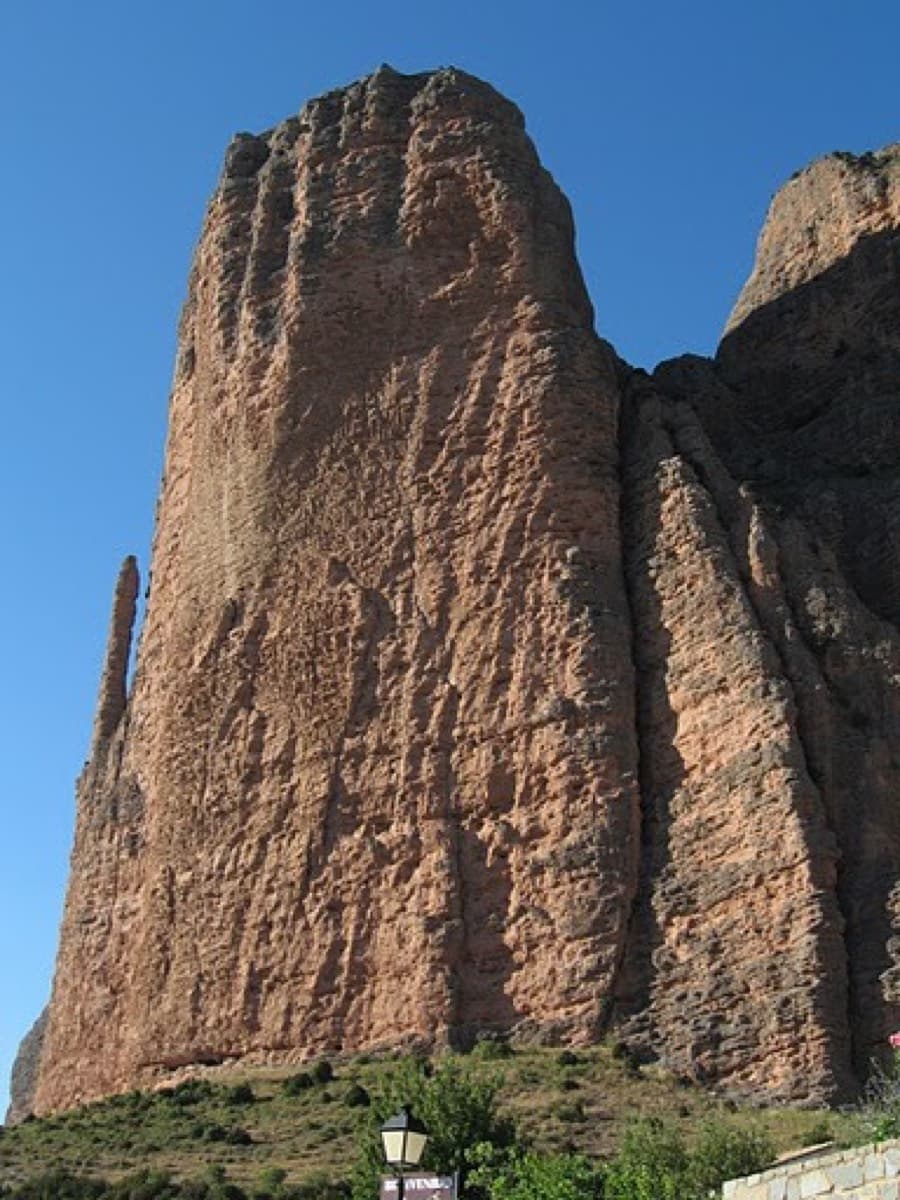
  • OverviewLa Visera, labelled, seen from below; the routes climb the big overhanging orange face.Photo: FMJ · CC BY-SA 3.0

Approach photo

Map of the walk-in

  • Crag

Loading map

The point marks the crag, not the exact start of the route.

Coordinates · crag

42.35061, -0.72361

Point from camptocamp waypoint 39757

For your phone or watch

Download GPX

Contains the route point. Opens in most mapping apps and GPS watches.

Points are compiled from published sources, with the precision stated above. They were not surveyed on the ground: check them against a current topo.

Getting down

Descent

On foot, as for the Fiesta. From the summit terrace take the cairned path north down the east flank of the Visera, through a wood, to just below a col. Either drop east down a small path into the gorge and back to the foot of the wall (20 to 30 min, rough), or go over the col and follow cairns and then the blue-marked path to the Circo de Verano between the Pisón and the Firé and the hiking path to the village (about 45 min).

Retreat

Bailing off the route

Committing

Camptocamp states that after the third belay you have to finish over the top, because the wall overhangs more with every pitch. Below that, retreat by abseil from the first belays is plausible but not described.

Retreat from
Belays 1 to 3 (inferred). The second belay is on the big terrace shared with Moskitos.
Point of no return
The third belay.
Carry
Two ropes or a willingness to leave gear for a low retreat (pitches 1 and 2 are 45 m each and diagonal). Higher up, the ability to rest on and pull between bolts and to climb the rope after a fall.
Basis
Part stated, part inferredThe point of no return is stated in the camptocamp remarks; abseil retreat from the lower belays is inferred from the pitch lengths and bolted belays.

Partly inferred from the route facts

Safety

Hazards

  • The face is concave: it overhangs more and more, and after the third belay the only practical way out is the top.
  • The crux comes last, with tired arms, above the full height of the wall.
  • Bolts are spaced on the lower pitches.
  • The start is easily confused with Super Crack.
  • Polished rock low down.

Sun and weather

Conditions

South-facing and unclimbable in hot weather. Good from autumn to spring: reports from late October (16°C) to late December (12°C, full sun) describe ideal conditions. The first moves and some cobbles are polished and feel greasy when warm or damp.

Usual season · Feb to May, Oct to Dec

Sun on the wall · S-facing

Working out the sunlit hours for this month.

  • January: not yet worked out
  • February (usual season): not yet worked out
  • March (usual season): not yet worked out
  • April (usual season): not yet worked out
  • May (usual season): not yet worked out
  • June: not yet worked out
  • July: not yet worked out
  • August: not yet worked out
  • September: not yet worked out
  • October (usual season): not yet worked out
  • November (usual season): not yet worked out
  • December (usual season): not yet worked out

Sun on the wallDaylight, wall in shade● Usual season

Estimated from the wall's aspect only. Ignores surrounding terrain, gullies and the wall's exact shape. Clock times are local to the wall (Central European time), for the 15th of each month.

Climate figures for Riglos & Agüero (Mallos) are not available yet

What to carry

Gear

Camptocamp says 16 quickdraws including long ones for the bulges and the diagonals. A 2025 party used no more than 12, noting you would use all 16 only if you clip the threads and old 8 mm bolts as well. Single 60 m rope. Helmet.

Checklist

Quickdraws
16
Rope
1×60 m (walk-off)
Helmet
One each

Derived from the route data; check it against a current topo

From climbers

Reader reports

Reader reports are not being collected yet. Until they are, check a current topo and the local club or guidebook publisher for recent changes to Zulú Demente.

Worth knowing

Tips

  • Allow 4.5 to 6 hours.
  • With rests on the bolts a 6b climber with some strength left can get up the last pitch, according to camptocamp, but it is not a bolt ladder.
  • Stop at the first belay just over the lip to enjoy the position, then move up to the terrace.
  • A tall climber can clip the first bolt of pitch 7 from the belay.

Open questions

Where sources disagree

  • Last pitch: 7a to 7a+ in the French camptocamp text, 7a in the camptocamp header, 7b in the Spanish text, '7b or 6b/A0' on the photo-topo and '7a/A0' on the older sketch. A March 2025 party who climbed the direct start called it 'a solid 7a rather than 7b'.
  • A0: the original topo gives A0 for the start and the exit, but camptocamp points out you cannot go strictly from bolt to bolt on the exit.
  • The older hand-drawn topo shows eight pitches with different grades (6a+, 6a, 6a, 6b, 6b, 6a, 6a+, 7a/A0) and 300 m; the current description has seven pitches and about 250 m. The camptocamp pitch lengths add up to 230 m.
  • Quickdraws: 16 (camptocamp), 14 (old sketch), 12 used by a 2025 party.

Provenance

Sources

Same area

More in Riglos & Agüero (Mallos)

All routes in Riglos & Agüero (Mallos)
The Adamelo spur on Mallo Pisón, Riglos

Spain · Riglos & Agüero (Mallos)

Espolón del Adamelo

This is the gentlest way to sample Riglos. Polished pockets and two bulging 'panzas' lead to a 6a crux that can be pulled through on the bolts (A0). The upper spur is easy, and the Pisón towers loom close by.

6a7 pitches175 m

Read the cautions
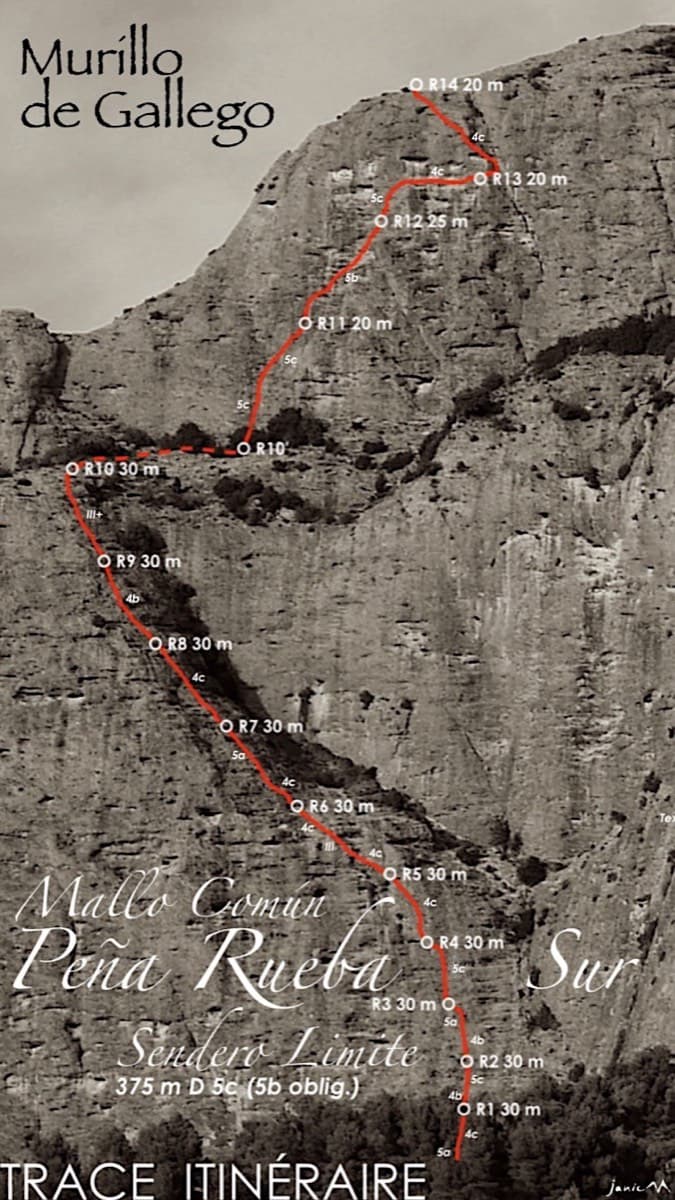
Topo of Sendero Límite on the south face of Peña Rueba (Mallo Común)

Spain · Riglos & Agüero (Mallos)

Sendero Límite

A long beginner's big route on good conglomerate at a moderate angle. Pitches can be linked in pairs with a 60 m rope. A four-pitch headwall with a couple of panzas finishes high above the Gállego valley.

5c14 pitches375 m

Topo of Tierra de Naide, Mallos de Agüero

Spain · Riglos & Agüero (Mallos)

Tierra de Naide

A morning-sun route at the quieter Agüero mallos. Easy slabs separate two fine steep walls, including a superb vertical 5c plaque on pitch 4. Take care with some loose cobbles on the last traverse.

5c5 pitches145 m

Around 7a · about 7 pitches

Similar elsewhere

The start of Alfredo Alfredo at the foot of the east face of Monte Oddeu

Italy · Sardinia

Alfredo Alfredo

Two pitches of bridging up a 60 m corner hung with tufas and stalactites (6c+, 6c), then grey water-drop walls and a short roof at 7a that goes in three moves of aid. Seven pitches of varied climbing on perfect, unpolished rock.

7a7 pitches220 m

Looking up pitch 2 (7a) of Jardins secrets from the first belay on the Grande Face of the Baou de Saint-Jeannet

France · Baou de Saint-Jeannet

Jardins secrets

One of the essential long routes of the Baou: seven pitches that hardly drop below the sixth grade, each with a different problem, from thin slab to a steep bulge and a superb layback corner at 6c. The single 7a section on pitch 2 is closely bolted and can be aided. Expect a few loose blocks and a scrappy link pitch across the Vernet ledge.

7a7 pitches200 m

Read the cautions

The Barberine wall with the line of Méduse drawn in red

France · Chamonix valley

Méduse

A direct line up the big south-facing slabs of Barberine: three pitches of friction slab to warm up, then steeper, technical walls on small holds. The two top pitches are graded 6b+ and 6c+ if you step round the bolts and 7a if you climb straight up them; 6c is obligatory.

7a7 pitches230 m

The entrance to the Todra Gorge with the Mansour wall labelled; China Perdida is on its right-hand part

Morocco · Todra Gorge (Todgha)

China Perdida

Steep, fingery wall climbing that starts with your feet almost in the stream at the gorge entrance. The 7a second pitch is hard for only 2 to 3 metres and can be swapped for a 6b pitch on the neighbouring route, after which three pitches of 6b+ to 6c+ on pocketed and edgy rock lead to the top. Abseil descent.

7a6 pitches200 m

Read the cautions

Compiled from published sources and last verified October 2026. Bolts, anchors and access change. Climbing is dangerous and you are responsible for your own decisions: check a current topo and read the disclaimer.