Multipitch Atlas

Jardins secrets

Grande Face · Baou de Saint-Jeannet · France

Read the cautionsBail with caveatsBolting confidence: high

One of the essential long routes of the Baou: seven pitches that hardly drop below the sixth grade, each with a different problem, from thin slab to a steep bulge and a superb layback corner at 6c. The single 7a section on pitch 2 is closely bolted and can be aided. Expect a few loose blocks and a scrappy link pitch across the Vernet ledge.

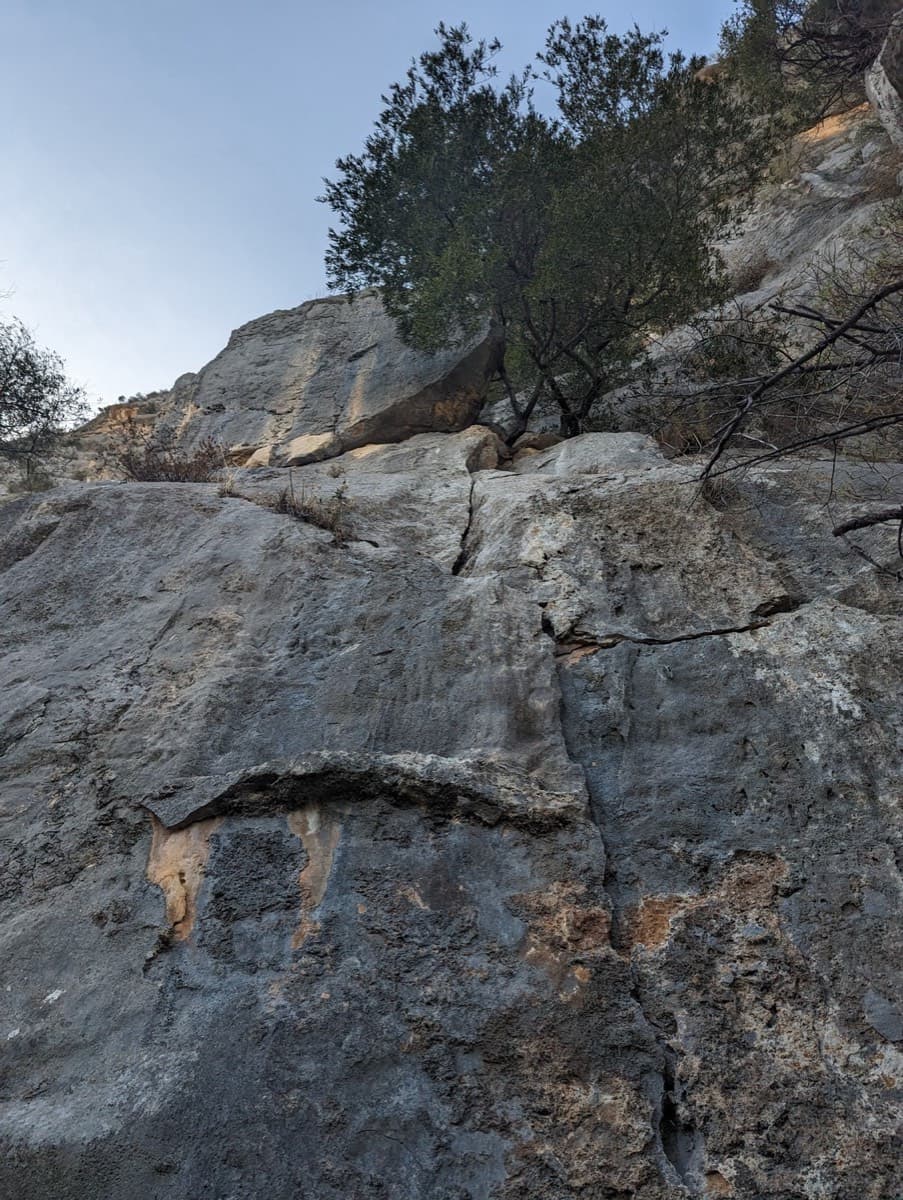
Looking up pitch 2 (7a) of Jardins secrets from the first belay on the Grande Face of the Baou de Saint-JeannetPhoto: kiwi_kiri · CC BY-NC-ND 3.0

Photo

Looking up pitch 2 (7a) of Jardins secrets from the first belay on the Grande Face of the Baou de Saint-JeannetPhoto: kiwi_kiri · CC BY-NC-ND 3.0
Hardest pitch
7a
Pitches
7
Length
200 m
Approach
20 min
Aspect
SW
South-west-facing
Rope
1×50 m
Read before you go

Solid glue-in equipment and an aidable crux, but with loose blocks and some run-out easier sections that keep it serious for the grade.

The route

Overview

Jardins secrets takes the Grande Face of the Baou left of the old Malet route, starting left of a big roof low on the wall and finishing near the summit. It was opened in 1998 by R. Gentili and P. Tardieu and is equipped on glue-ins, so route finding is a matter of following them. The climbing is sustained and varied: a slab with a hard move, a wall and overhang at 7a, a pillar and steep wall at 6c, a fine slab above the Vernet ledge, then the Gounand corner, a leaning layback crack at 6c. Alpes-Sud.net rates it ED-, 7a maximum and 6b obligatory, and calls it unmissable. Parties take 4 to 7 hours.
The climbing

Pitch by pitch

Pitches of Jardins secrets
PitchGradeLengthNotes
P16b40 mA big slab, thin at the start, then across a ledge to orange, broken rock and a small overhang. The hard move comes just after the last glue-in and the holds are hard to find. Alpes-Sud.net gives 6a+; several parties say 6b. There is no bolt between the end of the slab and the start of the orange rock, where the climbing is easy.
P27a40 mSlightly left of the belay, straight up a thin wall towards a hole, then diagonally left to a small overhang, over it and straight up to the belay. Very well protected and goes at 6b/A0. The end of the pitch is vegetated.
P36c35 mStarts right of the belay: slabs, a physical little pillar, then a straight, steep wall on horizontal strata with the 6c near the end and an athletic exit onto the ledge. After the tree, commit right, not left. One bolt after the flake is a long way off. A large loose block is reported near the third belay.
P4430 mA link pitch: one move of 4 above the belay, then grade 2 through bushes straight across the Vernet ledge. The belay is one enormous glue-in right of a clump of trees, under a fine grey slab. A 2018 party found only that single point.
P56b30 mA very fine, long vertical slab on small edges, straight up. Alpes-Sud.net and several parties call it a stiff 6a+; camptocamp says it goes at 6a/A0.
P66c30 mUp to the roof, then a beautiful leaning crack and corner on the right (the Gounand corner), best laybacked. Step left and climb a steep wall on small edges, where the 6c is. There is no bolt for the first 5 m above the belay and another gap of about 5 m between the middle of the crack and the mantel; a 2017 party found the exit from the crack bold.
P76a+–From the belay go right, traverse left on rock that is not clean, then back right up sculpted rock to the top. The first 5 m still had unstable blocks in January 2025. A few tens of metres of easy ground lead to the summit.

Getting there

Approach

To the parking

Saint-Jeannet is reached via Carros and Gattières from the north, La Gaude from the south-east, or Vence. Park at the car park at the entrance to the village: driving through it is reserved for residents. Bus line 510 of the Alpes-Maritimes network is listed on camptocamp as serving the village.

On foot · about 20 min

About 20 min. Walk through the village (rue Sainte-Barbe, rue du Château, rue Sainte-Claude) to the chapel of Notre-Dame-des-Champs and take the concrete path behind it. Past a statue of the Virgin and a rock step, take the path that goes left until it meets a rocky gully leading up to the big face. Climb the gully (grade 3, a few bolts, polished) and leave it on the right; a January 2025 party found fixed ropes on the right leading to the foot of the face. Follow a ledge right to the base of a well-defined slab below the start of the Malet, left of the plumb line of a big roof. The first glue-ins are visible, left of the Malet corner; do not climb that corner.

Finding the route · 3 photos

Approach photo

Map of the walk-in

  • Crag
  • Parking

Loading map

The point marks the crag, not the exact start of the route.

Coordinates · crag

43.75082, 7.13748

Parking

43.75001, 7.14479

Saint-Jeannet village (camptocamp waypoint 122004); use the car park at the village entrance

Point from camptocamp waypoint 41705

For your phone or watch

Download GPX

Contains the route point and parking. Opens in most mapping apps and GPS watches.

Points are compiled from published sources, with the precision stated above. They were not surveyed on the ground: check them against a current topo.

Getting down

Descent

On foot by the normal route of the Baou, a signposted walking path with yellow marks from the summit to the village. Camptocamp gives 20 min, Alpes-Sud.net 45 min. Abseiling the route is advised against because of rope snags and stonefall.

Retreat

Bailing off the route

Bail with caveats

Camptocamp advises against abseiling the route because ropes snag and stones fall, but does not say it is impossible, and the belays are big glue-ins. The Vernet ledge at the top of pitch 4 crosses the face; a neighbouring route's page says the ledge can be reached by skirting the cliff, which suggests a way off there, though no source describes it as an escape from this route.

Retreat from
The glue-in belays of pitches 1 to 3, by abseil (discouraged). The Vernet ledge after pitch 4 (inferred).
Point of no return
Not stated. Above the Vernet ledge the hard climbing on pitches 5 and 6 is partly obligatory and run-out in places.
Carry
Two ropes for the 40 m lower pitches if you abseil, and maillons or cord, as abseil hardware is not confirmed.
Basis
Part stated, part inferredThe warning against abseiling is stated on camptocamp; the ledge escape and gear needs are inferred.

Partly inferred from the route facts

Safety

Hazards

  • Loose rock: unstable blocks on ledges, a big block near the third belay, and loose blocks in the first metres of pitch 7.
  • Run-outs of about 5 m on easier ground on pitches 1 and 6, and a bold exit from the crack on pitch 6.
  • The belay at the top of pitch 4 is a single large glue-in.
  • Rue on pitches 4 and 5 in spring.
  • Other parties are often on neighbouring routes below and beside you; take care with loose stones.

Sun and weather

Conditions

South-west facing at 600 to 800 m. In July the sun reached the route at about midday; in January a party was in the sun all day at 10°C but chilled by wind at the belays. Pitches 4 and 5 are overgrown with rue, which can burn the skin when it flowers in spring.

Usual season · Jan to May, Oct to Dec

Sun on the wall · SW-facing

Working out the sunlit hours for this month.

  • January (usual season): not yet worked out
  • February (usual season): not yet worked out
  • March (usual season): not yet worked out
  • April (usual season): not yet worked out
  • May (usual season): not yet worked out
  • June: not yet worked out
  • July: not yet worked out
  • August: not yet worked out
  • September: not yet worked out
  • October (usual season): not yet worked out
  • November (usual season): not yet worked out
  • December (usual season): not yet worked out

Sun on the wallDaylight, wall in shade● Usual season

Estimated from the wall's aspect only. Ignores surrounding terrain, gullies and the wall's exact shape. Clock times are local to the wall (Central European time), for the 15th of each month.

Climate figures for Baou de Saint-Jeannet are not available yet

What to carry

Gear

12 to 14 quickdraws and a single 50 m rope (one party used 42 m). Take a 180 or 240 cm sling to link the widely spaced belay glue-ins. A January 2025 party notes that the gaps on easy ground could be protected with cams if you want; none are needed on the hard climbing. Helmet.

Checklist

Quickdraws
14
Rope
1×50 m
Helmet
One each
Abseil device and prusik
The descent or the retreat involves abseiling
Maillons or spare karabiners
To leave behind if you retreat
Cord
Mentioned for retreat

Derived from the route data; check it against a current topo

From climbers

Reader reports

Reader reports are not being collected yet. Until they are, check a current topo and the local club or guidebook publisher for recent changes to Jardins secrets.

Worth knowing

Tips

  • If you cannot free pitch 2, pull on the quickdraws: the obligatory level is about 6b.
  • Pitch 5 feels hard for the grade; keep something in reserve after the first three pitches.
  • Start early in warm weather to climb the lower pitches in shade.

Open questions

Where sources disagree

  • Pitch grades: camptocamp gives 6b, 7a, 6c, 4, 6b (6a/A0), 6c, 6a+; Alpes-Sud.net gives 6a+, 7a, 6c, IV, 6a+, 6c, 6a+. Camptocamp's are used.
  • Quickdraws: 14 (camptocamp) or 12 (Alpes-Sud.net).
  • Descent time: 20 min (camptocamp) or 45 min (Alpes-Sud.net).
  • Climbing time: 3 h 30 on Alpes-Sud.net; trip reports range from under 4 hours to 7.
  • Third belay: a 2017 report says it was moved lower, leaving the loose block above it on pitch 4; a 2018 party did not see the block.

Provenance

Sources

Around 7a · about 7 pitches

Similar elsewhere

The start of Alfredo Alfredo at the foot of the east face of Monte Oddeu

Italy · Sardinia

Alfredo Alfredo

Two pitches of bridging up a 60 m corner hung with tufas and stalactites (6c+, 6c), then grey water-drop walls and a short roof at 7a that goes in three moves of aid. Seven pitches of varied climbing on perfect, unpolished rock.

7a7 pitches220 m

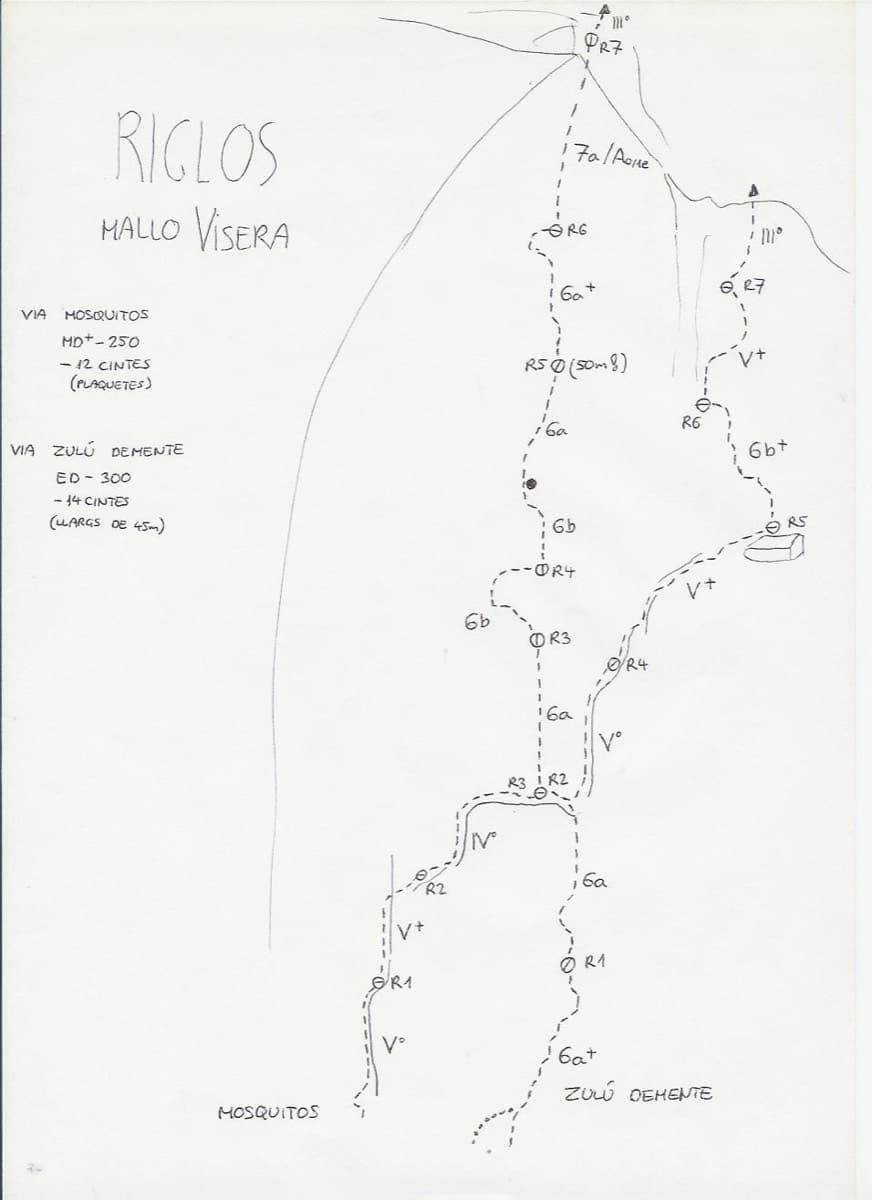
Hand-drawn topo of the Visera at Riglos showing Zulú Demente (right) and Moskitos (left)

Spain · Riglos & Agüero (Mallos)

Zulú Demente

The other great line of the Visera, on a concave wall that leans further out the higher you go. Six pitches at 6a to 6b on big cobbles lead to the vulture ledge, then one short, very overhanging crux pitch above enormous exposure. That last pitch is about 7a free, or roughly 6b to 6c with rests on its closely spaced bolts.

7a7 pitches250 m

Read the cautionsCommitting

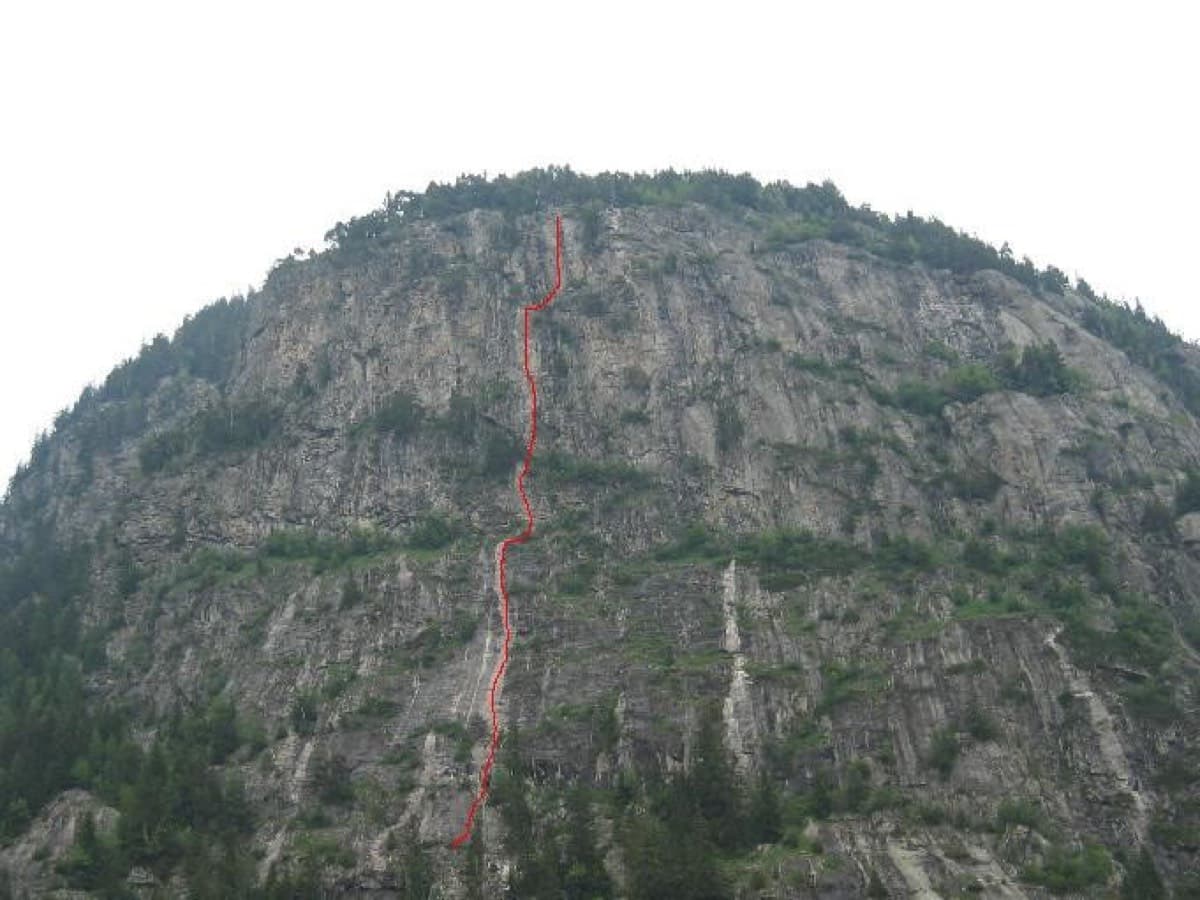
The Barberine wall with the line of Méduse drawn in red

France · Chamonix valley

Méduse

A direct line up the big south-facing slabs of Barberine: three pitches of friction slab to warm up, then steeper, technical walls on small holds. The two top pitches are graded 6b+ and 6c+ if you step round the bolts and 7a if you climb straight up them; 6c is obligatory.

7a7 pitches230 m

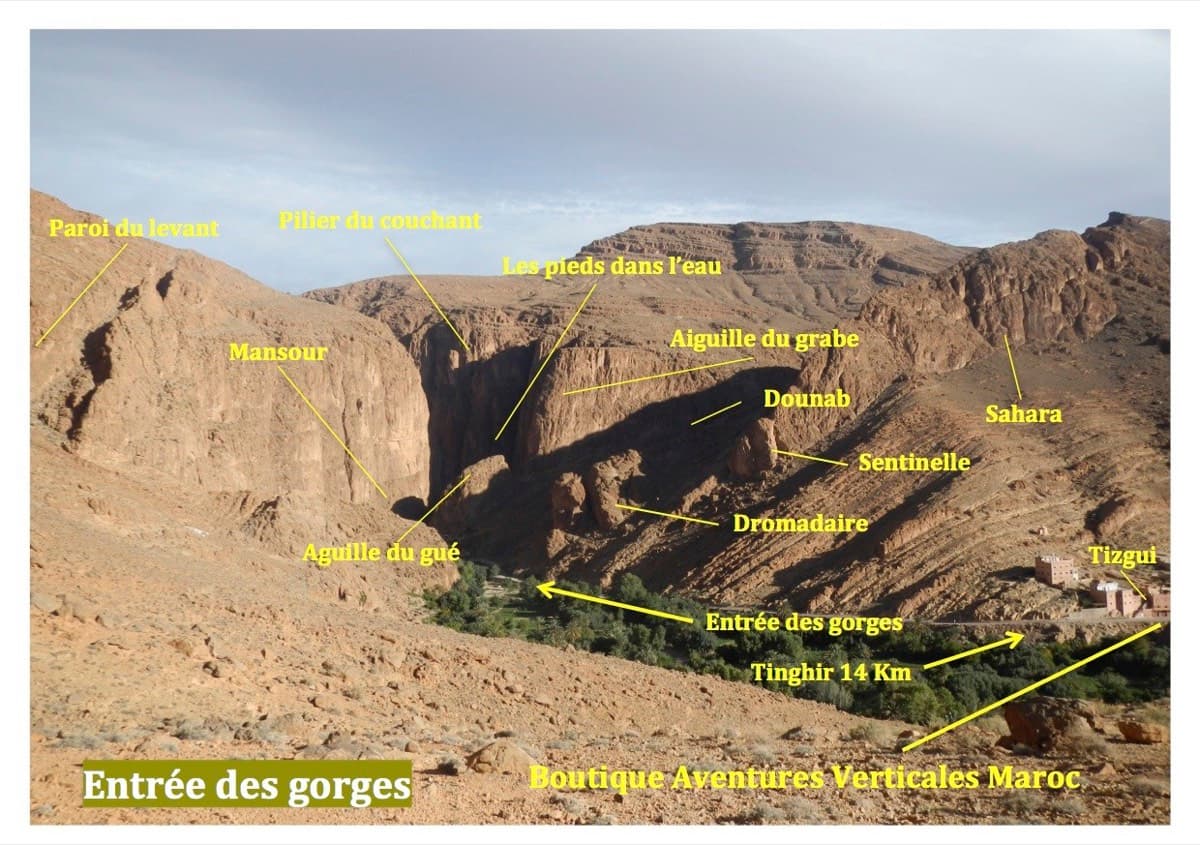
The entrance to the Todra Gorge with the Mansour wall labelled; China Perdida is on its right-hand part

Morocco · Todra Gorge (Todgha)

China Perdida

Steep, fingery wall climbing that starts with your feet almost in the stream at the gorge entrance. The 7a second pitch is hard for only 2 to 3 metres and can be swapped for a 6b pitch on the neighbouring route, after which three pitches of 6b+ to 6c+ on pocketed and edgy rock lead to the top. Abseil descent.

7a6 pitches200 m

Read the cautions

Compiled from published sources and last verified October 2026. Bolts, anchors and access change. Climbing is dangerous and you are responsible for your own decisions: check a current topo and read the disclaimer.