Multipitch Atlas

Alfredo Alfredo

Monte Oddeu, east face (Dorgali) · Sardinia · Italy

Bail with caveatsBolting confidence: high

Two pitches of bridging up a 60 m corner hung with tufas and stalactites (6c+, 6c), then grey water-drop walls and a short roof at 7a that goes in three moves of aid. Seven pitches of varied climbing on perfect, unpolished rock.

The start of Alfredo Alfredo at the foot of the east face of Monte OddeuPhoto: Martin Gallon · CC BY-NC-ND 3.0

Photo

The start of Alfredo Alfredo at the foot of the east face of Monte OddeuPhoto: Martin Gallon · CC BY-NC-ND 3.0
Hardest pitch
7a
Pitches
7
Length
220 m
Approach
20 min
Aspect
E
East-facing
Rope
1×60 m for the walk-off, 2×50 m to abseil

The route

Overview

Alfredo Alfredo takes the big corner on the central part of the east face of Monte Oddeu, above the Oddoene valley near Dorgali. Corrado Pibiri and Fabio Erriu opened it in 2012 as one of a group of 200 m 'plaisir' routes, entirely bolted with 6a obligatory climbing. After an approach pitch, the corner gives two outstanding pitches of stemming on concretions; the upper half changes to grey walls with pockets and flutings. The single 7a section is a short roof on pitch 6 that parties regularly pass on aid, and several felt the route overall nearer TD+ than its ED- label.

The climbing

Pitch by pitch

Pitches of Alfredo Alfredo
PitchGradeLengthNotes
P15c30 mApproach pitch: a crack, then slab with a few perched blocks.
P26c+30 mThe start of the corner. Gentle at first and very closely bolted (skip some to save drag), then the good holds thin out and the difficulty builds to the end. Belay under a stalactite. Bridging more than strength; some parties found it 6b+.
P36c30 mThe corner continues, slanting left, with a small traverse on undercuts and tufa features. The best pitch of the route.
P45c15 mTraverse left with an awkward start and air beneath you, then straight up. Route-finding crux: do not stop at the first chained belay; go on to the next one just to the left. Some give 5c+.
P56a+30 mA wall of flakes, then grey Verdon-style rock. Not so easy, and the bolts are further apart. Camptocamp gives 6a/6a+.
P67a25 mA vertical start on small edges slanting right (the bolts to the left are Madame Bovary), then a roof on positive edges with one very hard closing move. The roof goes on aid in about three moves.
P76a+50 mSteep to slightly overhanging on big fluted holds, in different rock again; very long, with the bolts spacing out.

Getting there

Approach

To the parking

From Dorgali drive the SS125 south towards Baunei, pass the Cala Gonone turn-off and at the next junction turn right down a small road into the Oddoene valley, following signs for Gola di Gorropu. There is a paid car park (8 euros in 2024) just before the concrete bridge over the river; the face is directly opposite. To avoid the fee, cross the bridge, turn right along the track and park at its end, where there are a few spaces.

On foot · about 20 min

15 to 20 minutes. After the bridge take the track on the right, then leave it at a cairn and a gap in the fence and follow the fence line on a marked but overgrown path to the foot of the wall. Follow a track along the base to below the obvious corner. The route is just right of Madame Bovary and right of the slabs of La mia Africa; the name is painted in faded yellow at the base.

Map of the walk-in

  • Crag

Loading map

The point marks the crag, not the exact start of the route.

Coordinates · crag

40.20153, 9.50377

Point from camptocamp waypoint 273479

For your phone or watch

Download GPX

Contains the route point. Opens in most mapping apps and GPS watches.

Points are compiled from published sources, with the precision stated above. They were not surveyed on the ground: check them against a current topo.

Getting down

Descent

On foot: from the top go north over easy rocks, following cairns, down to the valley floor, then take the path on the other side (shared with the Surtana approach) back to the fence and the car. It starts easily, becomes steeper and slippery, and the last part is scrubby and less clear; if you reach a small cave, go back. Allow 25 to 45 minutes. Alternatively abseil Madame Bovary with two ropes.

Retreat

Bailing off the route

Bail with caveats

Camptocamp gives abseiling Madame Bovary, the adjacent route, as the alternative descent, and the belays are bolted, some of them chained. No source describes abseiling Alfredo Alfredo itself, and the corner pitches slant and pitch 4 traverses.

Retreat from
From the top via Madame Bovary; from the belays of the first three pitches, which are 30 m each (inferred).
Point of no return
Not documented. After the pitch 4 traverse, retreating down the line you climbed becomes awkward.
Carry
Two 50 m ropes. The hard sections can be aided on the bolts, which often makes finishing the easier option.
Basis
Part stated, part inferredThe Madame Bovary abseil and rope lengths are stated on camptocamp; retreat from the lower belays is inferred.

Partly inferred from the route facts

Safety

Hazards

  • Uneven bolting: very close in the corner, noticeably wider on pitches 5 and 7. A 2023 party describes bolts missing where they would be useful on easier ground.
  • Without aid the route needs about 6b obligatory on the key pitches; PlanetMountain quotes 6a obligatory.
  • Easy to go wrong at the end of pitch 4 (wrong chained belay) and at the start of pitch 6 (Madame Bovary's bolts to the left).
  • A few perched blocks on pitch 1.
  • The end of the walk-off is hard to follow.

Sun and weather

Conditions

East facing: in the sun through the morning, with shade arriving on the upper pitches in the afternoon. Parties in late September and October with 30°C in the shade found it far too hot until the top; pick cool days or start late. The rock is rough and unpolished.

Usual season · Mar to May, Oct to Nov

Sun on the wall · E-facing

Working out the sunlit hours for this month.

  • January: not yet worked out
  • February: not yet worked out
  • March (usual season): not yet worked out
  • April (usual season): not yet worked out
  • May (usual season): not yet worked out
  • June: not yet worked out
  • July: not yet worked out
  • August: not yet worked out
  • September: not yet worked out
  • October (usual season): not yet worked out
  • November (usual season): not yet worked out
  • December: not yet worked out

Sun on the wallDaylight, wall in shade● Usual season

Estimated from the wall's aspect only. Ignores surrounding terrain, gullies and the wall's exact shape. Clock times are local to the wall (Central European time), for the 15th of each month.

Climate figures for Sardinia are not available yet

What to carry

Gear

16 quickdraws. Camptocamp says a single 50 m rope is enough if you walk off and 2×50 m if you abseil; a 2023 party measured the last pitch at about 50 m, so a 60 m rope gives a margin. One 2024 party carried cams (0.4 to 0.75) and two slings for the easier pitches; most do not. Helmet.

Checklist

Quickdraws
16
Rope
1×60 m for the walk-off, 2×50 m to abseil
Helmet
One each
Abseil device and prusik
The descent or the retreat involves abseiling

Derived from the route data; check it against a current topo

From climbers

Reader reports

Reader reports are not being collected yet. Until they are, check a current topo and the local club or guidebook publisher for recent changes to Alfredo Alfredo.

Worth knowing

Tips

  • Allow 3 to 5 hours on the route.
  • The first three pitches alone make a fine outing if the heat or the 7a puts you off; one party did just that.
  • On the way back along the track there is a place selling wine and goat's cheese, recommended on the camptocamp page.

Open questions

Where sources disagree

  • Length: 220 m on camptocamp, 200 m on PlanetMountain and Climbing Italy; pitch lengths measured by a 2023 party add up to 210 m.
  • Obligatory grade: 6a (PlanetMountain), 6a+ (camptocamp), about 6b by a 2023 party.
  • Bolting: 'too well equipped' on the camptocamp page; a 2020 party disagreed, and 2023 and 2024 parties call it generous but illogical.
  • Pitch 4 is 5c on camptocamp and 5c+ in two trip reports; pitch 5 is 6a/6a+ or 6a+.

Provenance

Sources

Same area

More in Sardinia

All routes in Sardinia
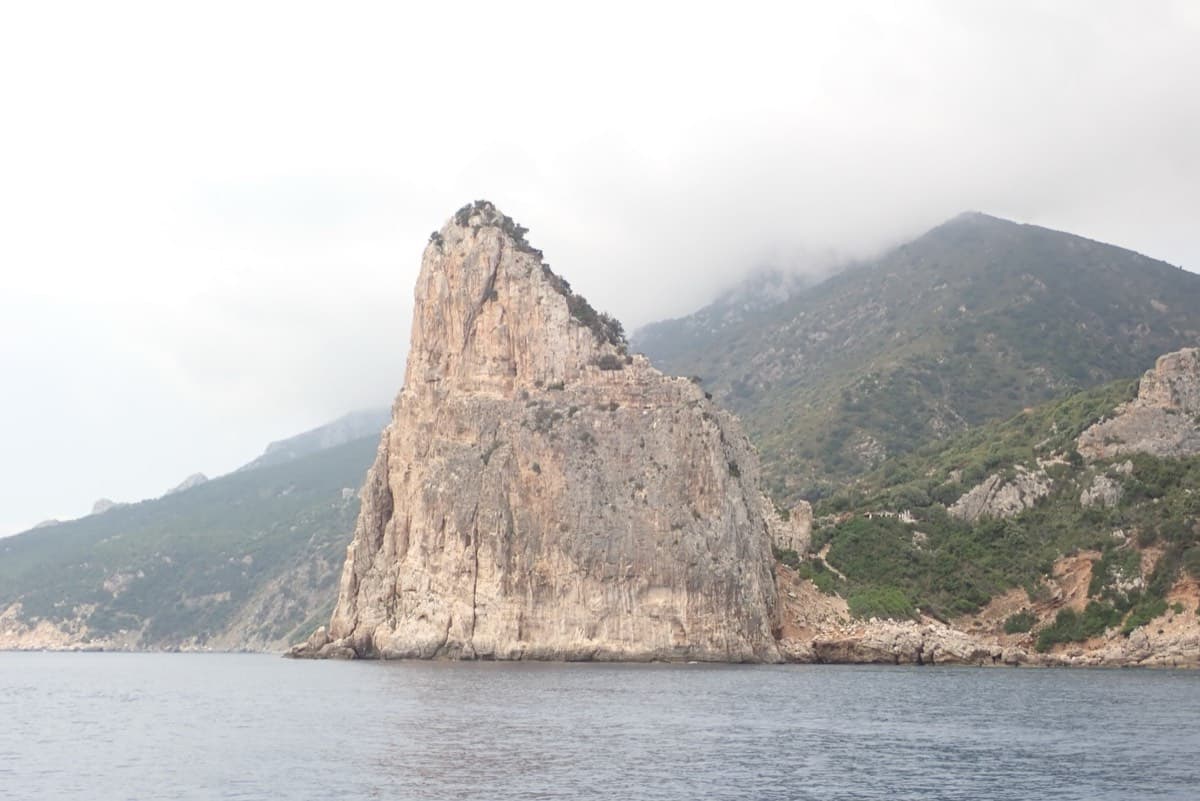
Pedra Longa, Baunei, seen from the sea

Italy · Sardinia

Marinaio di Foresta

An airy, mostly left-rising traverse that spirals round the Pedra Longa sea stack to its summit, on water-runnelled grey walls and pocketed white rock right above the sea. It has become one of the most popular routes in Sardinia, so expect queues.

6a+7 pitches190 m

Committing
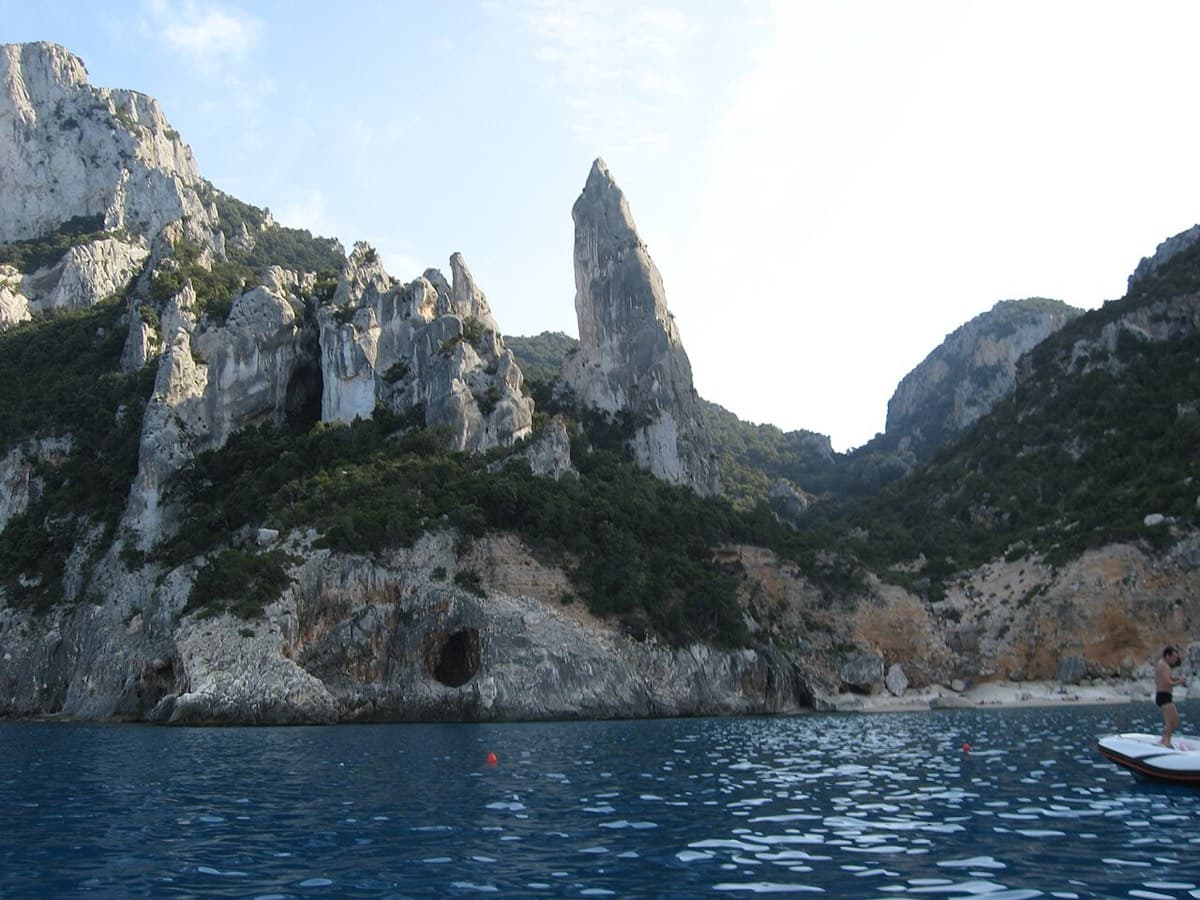
The Aguglia di Goloritzè above Cala Goloritzè, seen from the sea

Italy · Sardinia

Easy Gymnopédie

This is the easiest way to the top of Sardinia's iconic 140 m pinnacle above Cala Goloritzè. Short technical bulges and walls lead to a fine slab finish, and the harder overhangs can be aided. Gulliver splits it into 4 pitches; camptocamp gives 5. Check seasonal access rules for Cala Goloritzè before going.

6b5 pitches150 m

Read the cautions

The Masua sea cliffs seen from the water

Italy · Sardinia

L'Italia Liberata

A short but superb sea-cliff route on beautifully sculpted limestone in an incredible setting near Pan di Zucchero. Corners and an airy pillar lead to a steep, rounded 6a wall. Camptocamp rates it 'great'.

6a4 pitches120 m

A chained belay on the pocketed limestone of Powaqqatsi, Capo Caccia

Italy · Sardinia

Powaqqatsi

The easiest line on the Capo Caccia sea cliff: six pitches of 4b to 4c on pocketed, sharply sculpted limestone above the open sea. You abseil in from the top and climb out. The first two pitches are vegetated; the climbing proper starts on the pitch 3 slab.

4c6 pitches145 m

Read the cautionsCommitting

Around 7a · about 7 pitches

Similar elsewhere

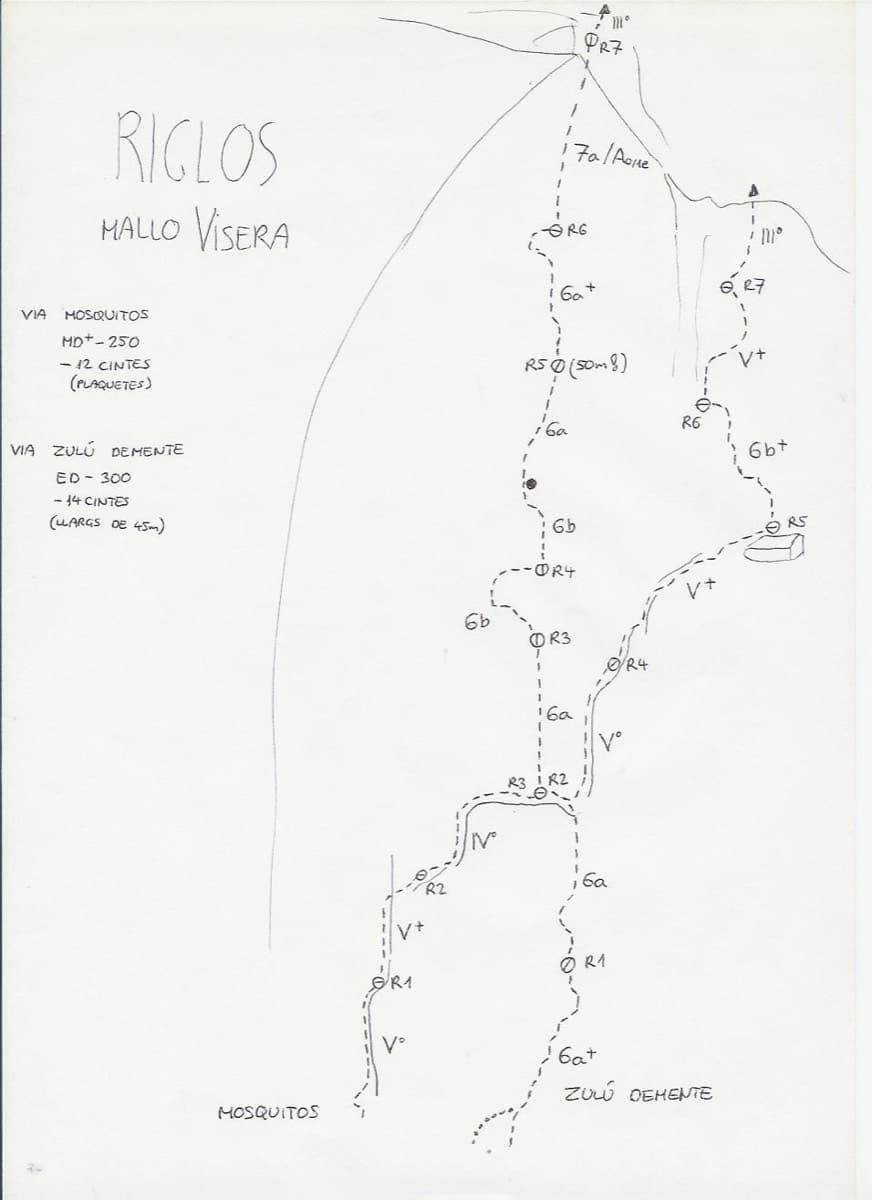
Hand-drawn topo of the Visera at Riglos showing Zulú Demente (right) and Moskitos (left)

Spain · Riglos & Agüero (Mallos)

Zulú Demente

The other great line of the Visera, on a concave wall that leans further out the higher you go. Six pitches at 6a to 6b on big cobbles lead to the vulture ledge, then one short, very overhanging crux pitch above enormous exposure. That last pitch is about 7a free, or roughly 6b to 6c with rests on its closely spaced bolts.

7a7 pitches250 m

Read the cautionsCommitting

Looking up pitch 2 (7a) of Jardins secrets from the first belay on the Grande Face of the Baou de Saint-Jeannet

France · Baou de Saint-Jeannet

Jardins secrets

One of the essential long routes of the Baou: seven pitches that hardly drop below the sixth grade, each with a different problem, from thin slab to a steep bulge and a superb layback corner at 6c. The single 7a section on pitch 2 is closely bolted and can be aided. Expect a few loose blocks and a scrappy link pitch across the Vernet ledge.

7a7 pitches200 m

Read the cautions

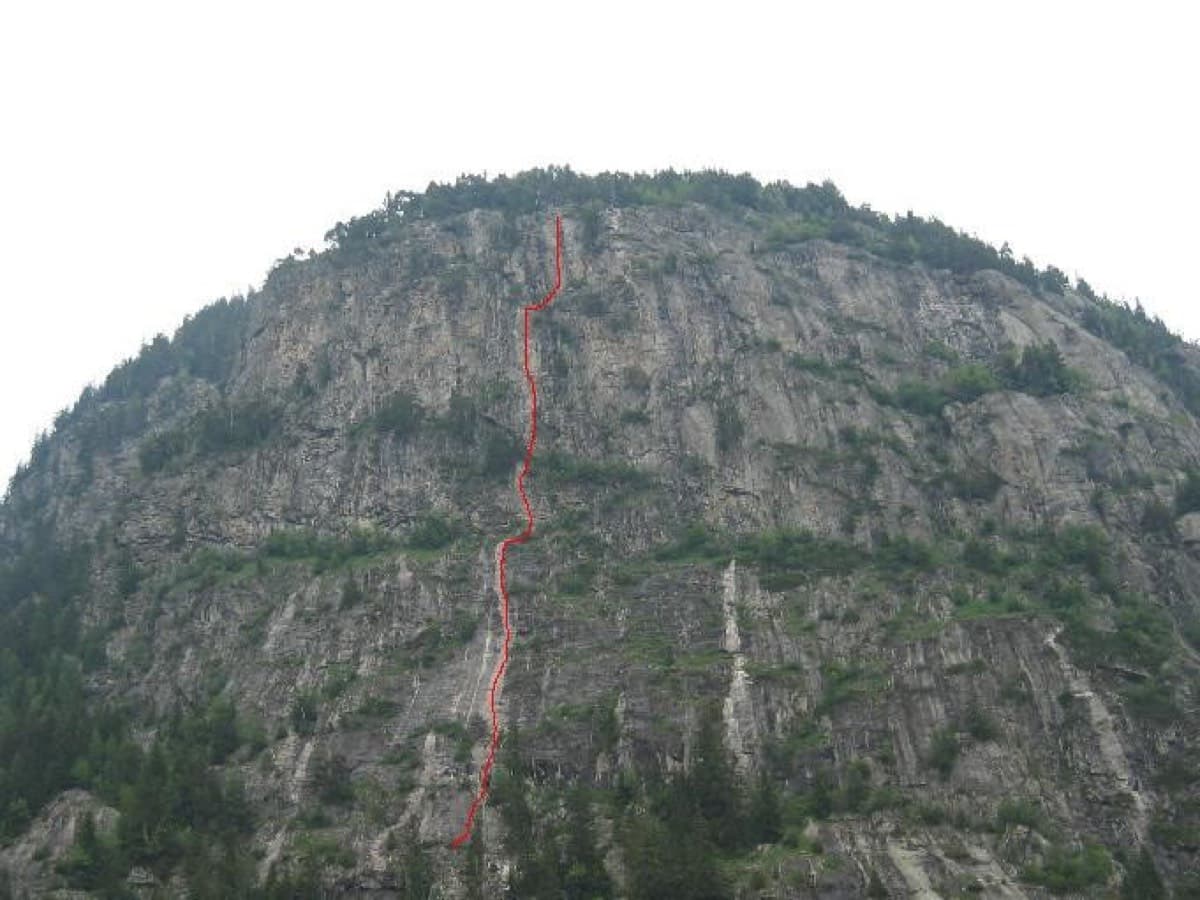
The Barberine wall with the line of Méduse drawn in red

France · Chamonix valley

Méduse

A direct line up the big south-facing slabs of Barberine: three pitches of friction slab to warm up, then steeper, technical walls on small holds. The two top pitches are graded 6b+ and 6c+ if you step round the bolts and 7a if you climb straight up them; 6c is obligatory.

7a7 pitches230 m

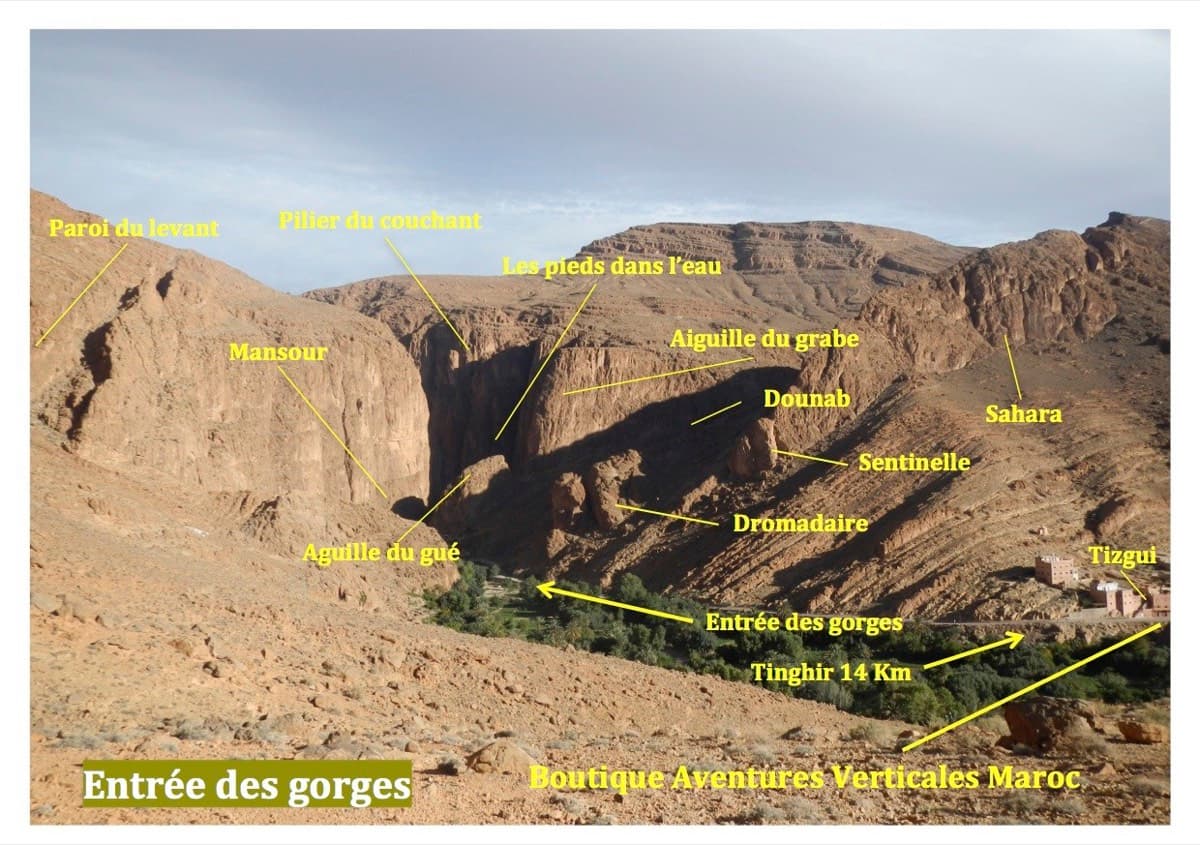
The entrance to the Todra Gorge with the Mansour wall labelled; China Perdida is on its right-hand part

Morocco · Todra Gorge (Todgha)

China Perdida

Steep, fingery wall climbing that starts with your feet almost in the stream at the gorge entrance. The 7a second pitch is hard for only 2 to 3 metres and can be swapped for a 6b pitch on the neighbouring route, after which three pitches of 6b+ to 6c+ on pocketed and edgy rock lead to the top. Abseil descent.

7a6 pitches200 m

Read the cautions

Compiled from published sources and last verified October 2026. Bolts, anchors and access change. Climbing is dangerous and you are responsible for your own decisions: check a current topo and read the disclaimer.