Multipitch Atlas

Chopper

Mallo Pisón, Riglos · Riglos & Agüero (Mallos) · Spain

Read the cautionsEasy to bailBolting confidence: medium

A fine short route on the right edge of the Pisón, ending on a big terrace at half height. A vertical wall on small holds on pitch 3 and two hard moves on the last pitch.

Line of Chopper / Chooperior marked on Mallo Pisón, RiglosPhoto: moms · CC BY-SA 3.0

Topo

Line of Chopper / Chooperior marked on Mallo Pisón, RiglosPhoto: moms · CC BY-SA 3.0
Hardest pitch
6b
Pitches
5
Length
150 m
Approach
–
Aspect
S
South-facing
Rope
2×50 m
Read before you go

Fully bolted, but with 1992 bolts spaced up to 5 to 6 m on stiff grade V ground, polish, and free-hanging abseils.

The route

Overview

A five-pitch route up the right edge of the main face of the Mallo Pisón, just left of the Pany-Haus chimney, ending on a big terrace at half height. It is steep bulge climbing with rests in between: three pitches of stiff grade V, a vertical 6a wall on small holds and a 6b final pitch with two hard moves over bulges. The bolts date from 1992 and are well placed on the cruxes but can be 5 to 6 m apart on easier ground, and the lower pitches are polished. Short and quick, but harder and bolder than the numbers suggest. Also written Chooper.

The climbing

Pitch by pitch

Pitches of Chopper
PitchGradeLengthNotes
P15c25 mSteep and committing for the grade (V on the local topo, which gives 30 m). There is an optional intermediate belay on two old bolts. Polished.
P25c25 mSome distance between bolts. The pitch ends up a fine coloured wall (the 'muro naranja', V+ on the local topo) with a hidden key hold, well protected. Polished.
P36a30 mA vertical wall on small, indistinct holds.
P45c30 mHard for the grade, through bulges and up the 'muro gris' (V and 40 m on the local topo). One report found the bolts more spaced here.
P56b30 mTwo hard moves over bulges, with two 6a moves before the crux; steep, on poor holds. The last bulge is fairly committing. The bolting lets you aid past the hard moves. Ends on a broad terrace (25 m on the local topo).

Getting there

Approach

To the parking

Riglos village (Las Peñas de Riglos) is about 45 km north-west of Huesca. From Huesca drive to Ayerbe, follow the A-132 towards Jaca and turn right after a few kilometres onto the small road to Riglos; from Pamplona or France (Somport, Jaca, Puente la Reina de Jaca) take the A-132 towards Ayerbe and turn left shortly after Murillo de Gállego. Parking is in the large pay car parks at the village entrance (3 EUR a day for cars, 6 EUR for vans in 2026). The refugio is the modern building on the left as you enter the village; there is a campsite at Murillo de Gállego.

On foot

Obvious from the village: walk up through the streets to the foot of the Pisón, a few minutes. It is the right-most route on the main face of the Pisón, immediately left of the very distinctive Pany-Haus chimney that separates the Pisón from the Macizo del Pisón.

Finding the route · 2 photos

  • OverviewThe Mallo Pisón (big tower, centre left) above Riglos village, with the Puro needle to its left. The red line and notes mark the Pisón descent: abseils to the col behind the tower, then cables and abseils down the gully on its right.Photo: Sype · CC BY-SA 3.0
  • Walk-inThe Pisón seen from the grassy slope above the village on the short walk to its foot.Photo: davaz · CC BY-NC-ND 3.0

Approach photo

Map of the walk-in

  • Crag

Loading map

The point marks the crag, not the exact start of the route.

Coordinates · crag

42.35056, -0.72811

Point from camptocamp waypoint 43230

For your phone or watch

Download GPX

Contains the route point. Opens in most mapping apps and GPS watches.

Points are compiled from published sources, with the precision stated above. They were not surveyed on the ground: check them against a current topo.

Getting down

Descent

Abseil the route. With 2×50 m ropes it goes in three abseils: R5 to R3 (pitches 5 and 4 together), R3 to R2, then R2 to the ground. The abseils hang free over the bulges: clip the rope through quickdraws as you descend the overhanging top pitch so you can regain the belays. The local topo also gives a descent by the Pany-Haus chimney line to the right. Alternatively continue to the top (see tips) and use the normal Pisón abseil descent.

Retreat

Bailing off the route

Easy to bail

Yes. The route is abseiled as its normal descent, and one party chose it in doubtful weather because it is easier to retreat from than most Riglos routes, then bailed after pitch 3. The abseils hang free over the bulges, so on steep sections clip the rope through quickdraws on the way down or you may not be able to reach the belay.

Retreat from
Any belay on the abseil line. The standard descent with 2×50 m is R5 to R3, R3 to R2, R2 to the ground. A retreat from R3 after pitch 3 is documented. From R5 you can also traverse 10 m (grade III) into the Pany-Haus chimney.
Carry
2×50 m (camptocamp suggests 2×60 m). A few quickdraws to use as directionals on the overhanging abseils.
Basis
Stated in the sourcesCamptocamp and trip reports state the three-abseil descent on 2×50 m, the free-hanging abseils and the party that bailed after pitch 3; only the idea that R1 and R4 serve equally well is inferred.

Safety

Hazards

  • Bolt spacing is uneven: close on the hard moves but 5 to 6 m apart in places on the grade V ground, with mantels and boulder moves in between (2016 report). The route was equipped from the ground up.
  • Bolts are 10 mm expansion bolts from the 1992 re-equipping.
  • Old-school grading: several reports say the grade V pitches are stiff and that a 5c/6a leader will be frightened. One suggests being solid at 6b.
  • Free-hanging abseils over the bulges; without directional quickdraws you can end up hanging in space away from the belay.
  • Polished rock on pitches 1 and 2.

Sun and weather

Conditions

Reports say the route is in shade in the morning and does not get the sun before midday in June, so start early on warm days. Too hot in full sun in late May. Polished on the first two pitches from heavy traffic.

Usual season · Feb to May, Oct to Dec

Sun on the wall · S-facing

Working out the sunlit hours for this month.

  • January: not yet worked out
  • February (usual season): not yet worked out
  • March (usual season): not yet worked out
  • April (usual season): not yet worked out
  • May (usual season): not yet worked out
  • June: not yet worked out
  • July: not yet worked out
  • August: not yet worked out
  • September: not yet worked out
  • October (usual season): not yet worked out
  • November (usual season): not yet worked out
  • December (usual season): not yet worked out

Sun on the wallDaylight, wall in shade● Usual season

Estimated from the wall's aspect only. Ignores surrounding terrain, gullies and the wall's exact shape. Clock times are local to the wall (Central European time), for the 15th of each month.

Climate figures for Riglos & Agüero (Mallos) are not available yet

What to carry

Gear

Camptocamp recommends 2×60 m ropes; 2×50 m is enough for the three abseils. The 1992 re-equippers' topo lists only 7 quickdraws plus belay gear, and a 2011 report notes bolts have been added in places since, so treat 7 as a minimum. Helmet.

Checklist

Quickdraws
Number not given in the sources
Rope
2×50 m
Helmet
One each
Abseil device and prusik
The descent or the retreat involves abseiling

Derived from the route data; check it against a current topo

From climbers

Reader reports

Reader reports are not being collected yet. Until they are, check a current topo and the local club or guidebook publisher for recent changes to Chopper.

Worth knowing

Tips

  • From R5 you can traverse 10 m (III) into the Pany-Haus chimney, or 25 m (III+) to the Espolón del Adamelo, and follow either to the Pisón col; an American party did two 5a pitches of Pany-Haus to reach the abseil line.
  • The harder continuation Chooperior (6c, 6a+, 5) leads from R5 to the summit of the Pisón.
  • Fast parties climb it in about 1.5 hours plus 30 minutes for the abseils; most take 2.5 to 3 hours.
  • One party chose it in doubtful weather because it is easier to retreat from than most Riglos routes, and bailed after pitch 3.

Open questions

Where sources disagree

  • Pitch lengths: Camptocamp gives 25, 25, 30, 30, 30 m; the re-equipper's topo gives 30, 25, 30, 40, 25 m. Total about 150 m either way.
  • Grades: the local topo gives V, V+, 6a, V, 6b; Camptocamp gives 5c, 5c, 6a, 5c, 6b. Reports find the grade V pitches hard.
  • Which pitch is run-out: Camptocamp says pitch 2, a US trip report says pitch 4, and a 2016 report mentions long gaps more generally.
  • Aspect: Camptocamp's text calls this the east face of the Pisón while its data field says south; reports of morning shade and sun from midday fit the south-facing aspect listed here better.
  • Rope: Camptocamp's gear line says 2×60 m, but three parties confirm three abseils on 2×50 m.

Provenance

Sources

Same area

More in Riglos & Agüero (Mallos)

All routes in Riglos & Agüero (Mallos)
The Adamelo spur on Mallo Pisón, Riglos

Spain · Riglos & Agüero (Mallos)

Espolón del Adamelo

This is the gentlest way to sample Riglos. Polished pockets and two bulging 'panzas' lead to a 6a crux that can be pulled through on the bolts (A0). The upper spur is easy, and the Pisón towers loom close by.

6a7 pitches175 m

Read the cautions
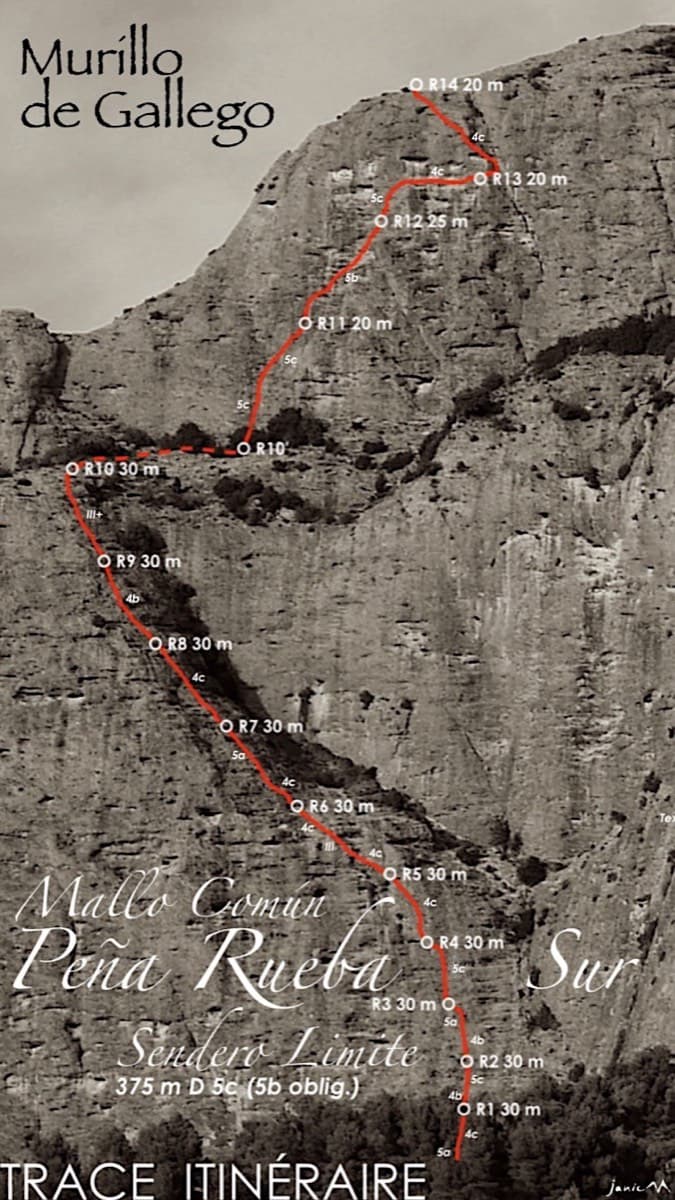
Topo of Sendero Límite on the south face of Peña Rueba (Mallo Común)

Spain · Riglos & Agüero (Mallos)

Sendero Límite

A long beginner's big route on good conglomerate at a moderate angle. Pitches can be linked in pairs with a 60 m rope. A four-pitch headwall with a couple of panzas finishes high above the Gállego valley.

5c14 pitches375 m

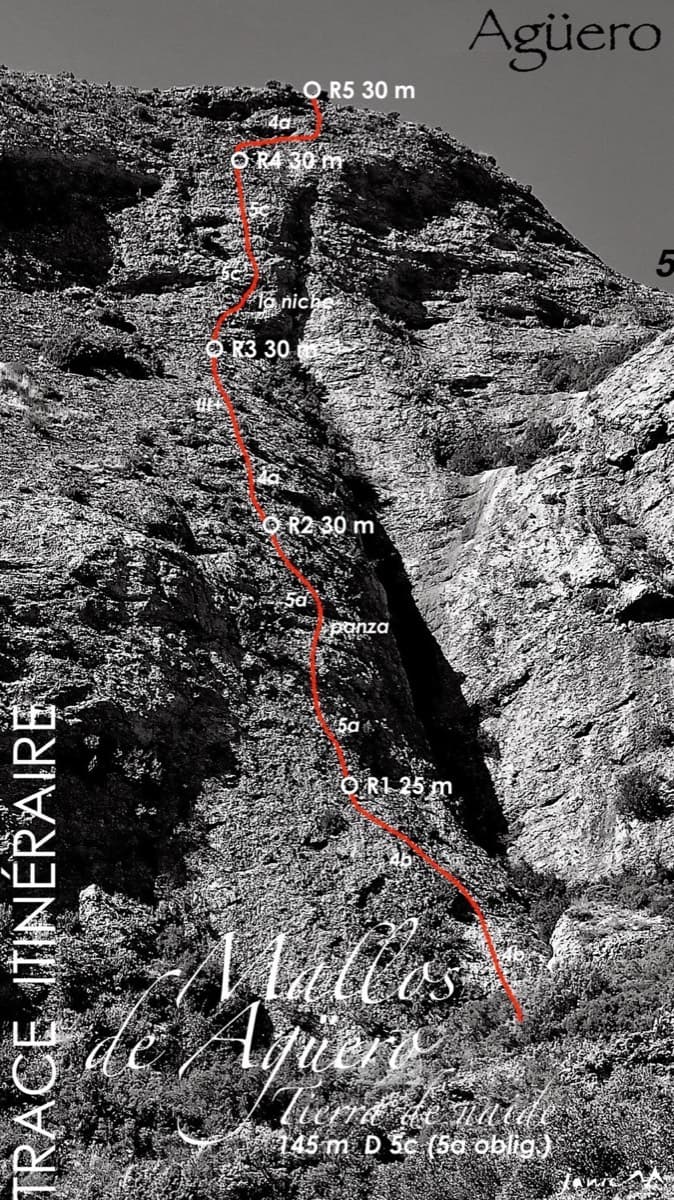
Topo of Tierra de Naide, Mallos de Agüero

Spain · Riglos & Agüero (Mallos)

Tierra de Naide

A morning-sun route at the quieter Agüero mallos. Easy slabs separate two fine steep walls, including a superb vertical 5c plaque on pitch 4. Take care with some loose cobbles on the last traverse.

5c5 pitches145 m

Around 6b · about 5 pitches

Similar elsewhere

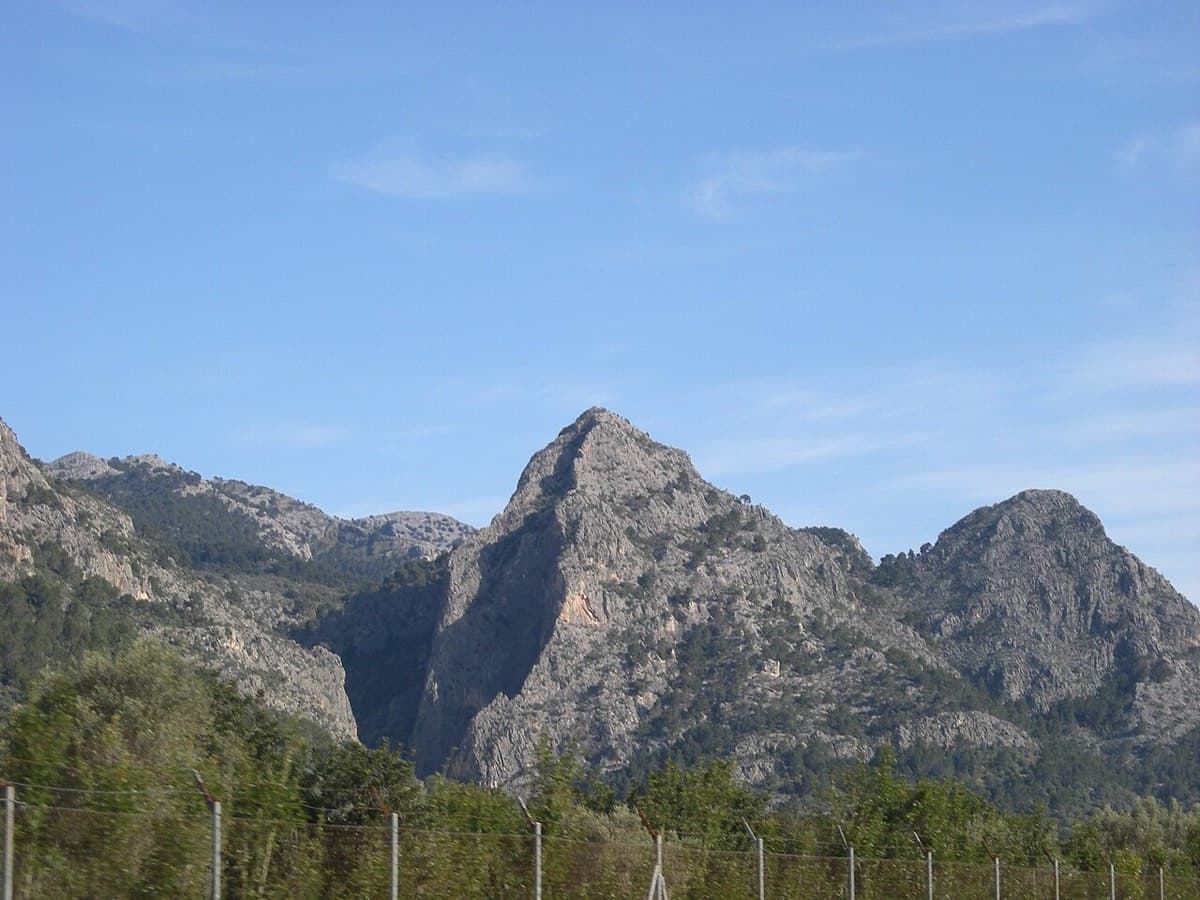
Sa Gubia seen from the Sóller road, Mallorca

Spain · Mallorca (Sa Gubia)

Via Llum de Lluna

Technical, sustained wall climbing on positive holds up the left side of the Princesa wall, ending in a memorable powerful finish.

6b5 pitches216 m

Read the cautions

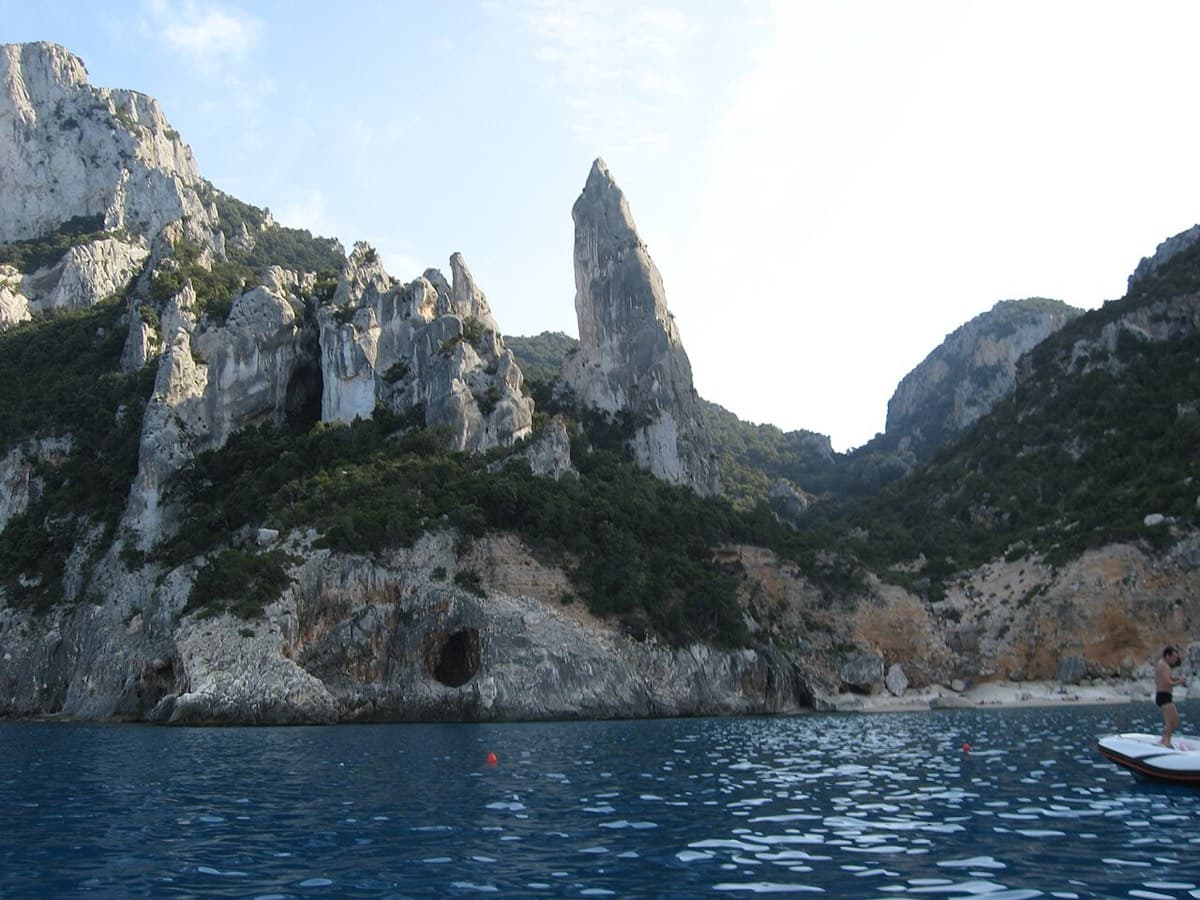
The Aguglia di Goloritzè above Cala Goloritzè, seen from the sea

Italy · Sardinia

Easy Gymnopédie

This is the easiest way to the top of Sardinia's iconic 140 m pinnacle above Cala Goloritzè. Short technical bulges and walls lead to a fine slab finish, and the harder overhangs can be aided. Gulliver splits it into 4 pitches; camptocamp gives 5. Check seasonal access rules for Cala Goloritzè before going.

6b5 pitches150 m

Read the cautions

No photo yet

Greece · Kalymnos & Telendos

Abert Project

A pretty route up the grey and orange walls of Ocean Dream to the summit plateau. The crux is a thin, sustained 6a+ slab on P3 where you must free the moves, and the line finishes on a vertical pillar. It is in the shade in the morning.

6b5 pitches150 m

Patchwork Family sector, Todra Gorge

Morocco · Todra Gorge (Todgha)

Polo del Sol

The only multipitch on a pillar about 800 m up the road from the gorge exit. Sustained at 6a+/6b on new, very abrasive rock, with a walk between pitches 2 and 3.

6b5 pitches210 m

Read the cautions

Compiled from published sources and last verified October 2026. Bolts, anchors and access change. Climbing is dangerous and you are responsible for your own decisions: check a current topo and read the disclaimer.