Multipitch Atlas

Anorexia

Mallo Colorado, Riglos · Riglos & Agüero (Mallos) · Spain

Bail with caveatsBolting confidence: high

The best-known route on the Mallo Colorado. Two steep, juggy panza pitches have a well-protected boulder move, giving a short taste of real Riglos steepness at a friendly grade.

Topo of Anorexia on Mallo Colorado, RiglosPhoto: janic · CC BY-SA 3.0

Topo

Topo of Anorexia on Mallo Colorado, RiglosPhoto: janic · CC BY-SA 3.0
Hardest pitch
5c
Pitches
4
Length
150 m
Approach
30 min
Aspect
SE
South-east-facing
Rope
1×50 m

The route

Overview

The best-known route on the Mallo Colorado (Colorao), the first separate tower right of the Visera at Riglos, and a common first taste of Riglos conglomerate. Two long pitches of steep, juggy climbing over a series of panzas are followed by an easy ramp and a short final wall. The steep sections are well bolted, including the boulder move on pitch 1; the easy ground is run-out. It is short, about 1 h 30 for most parties, and often busy.

The climbing

Pitch by pitch

Pitches of Anorexia
PitchGradeLengthBoltsNotes
P15b/5c40 m14 boltsAn easier plinth, then a succession of panzas that need a little route-reading, a passage between two distinctive blocks, and a last left-then-right bulge with a well-protected boulder move. The angle then drops and the rock becomes friable just before the two-ring belay. Recent parties counted 12 bolts.
P25b45 m10 boltsA wall slightly less steep than pitch 1, very even in difficulty, climbed as a series of steps. After an easier section a final bulge with one bolt and a small rib lead to the belay on 2 rings, on the left.
P33b30 m1 boltsGrade 2 to 3b. An easy-angled diagonal ramp with a single bolt, to a belay on one ring on the left.
P45b35 m4 boltsLeave R3 slightly leftwards and climb a vertical wall of 15–20 m (5b), with the first bolt a little far and a panza around the third; pull up to a good jug and squeeze through. The slab then lies back (4b) over loose gravel to the summit belay on a big ring.

Getting there

Approach

To the parking

Riglos is about 45 km north-west of Huesca on the left bank of the Río Gállego. From Huesca take the A-132 through Ayerbe towards Jaca and turn right to the village after a few kilometres; from Pamplona or France come via Puente la Reina de Jaca and the A-132 south, turning left shortly after Murillo de Gállego. You cannot drive into the village: use the pay car parks at the entrance (3 EUR per day in 2024–25; one report says cash only). There is a railway station just below the village. The climbers' refuge is the modern building between the bus and car parks.

On foot · about 30 min

About 30 min from the Riglos car park. Either go up through the top of the village and take the path up the barranco, or follow the GR1 out of the village and after a few hundred metres take the 'Camino del Cielo', the path that circles the Mallos. Climb towards the Mallo Colorado, then leave the Camino del Cielo to the left at a hairpin; the path is indistinct and partly hidden by low scrub. Anorexia is on the left-hand bolt line of the face, starting from a clearing, the large flat area on the path along the base. Look for a block lying on the ground to the left and a letter 'A' carved on a boulder of the conglomerate slightly right, with a bolt above it.

Finding the route · 3 photos

Approach photo

Map of the walk-in

  • Crag
  • GPS line

Loading map

The point marks the crag, not the exact start of the route.

GPS line: a line of the walk-in and the descent drawn by its source, not a recorded track. Line on the Camptocamp route page: loop from the Riglos car park to the Mallo Colorado and back. Do not follow it blindly.

GPS line: Camptocamp contributors · CC BY-SA 3.0

Coordinates · crag

42.35051, -0.72391

Point from OpenStreetMap node 659541730 (Mallo Colorado)

For your phone or watch

Download GPX

Contains the route point and a GPS line. Opens in most mapping apps and GPS watches.

Points are compiled from published sources, with the precision stated above. They were not surveyed on the ground: check them against a current topo.

Getting down

Descent

Preferred: from the last belay follow a cairned path for about 20 m up along the edge of the face to a juniper with a cable and a large metal ring. One abseil of 20–25 m (comfortable with a 50 m rope) lands on a stony, slightly outward-sloping ledge. Go left to a fixed rope that leads down to the col and the path, returning by the barranco path. A 2024 Mountain Project report describes the same descent as a single-60 m abseil to a ledge followed by an established hand line with little exposure. Alternative: three abseils down the route, but the abseil from R2 is 45 m, so this needs two ropes.

Retreat

Bailing off the route

Bail with caveats

Yes, but only with two ropes. Abseiling the route is a documented alternative in three abseils, and the abseil from R2 is 45 m. With the single 50 m rope the route is normally climbed on, you cannot get down from R2; from there it is easier to finish, since pitch 3 is an easy ramp and the normal descent is one short abseil off the back.

Retreat from
R1 and R2, both on two rings. R3 is a single ring. With one rope you can still lower or abseil from part-way up pitch 1 while you are within 25 m of the ground.
Point of no return
With a single rope, the top of pitch 2 (45 m above R1). Past it, going up is the practical way off.
Carry
Two ropes of at least 45 m, or a rope plus tagline. A single 50 m only covers the rear descent from the top.
Basis
Part stated, part inferredCamptocamp and Mountain Project state that the route can be abseiled in three with a 45 m abseil from R2 and that belays are on rings; the single-rope consequences are inferred.

Partly inferred from the route facts

Safety

Hazards

  • Abseiling the route needs two ropes: the abseil from R2 is 45 m (Mountain Project). With a single rope use the rear descent.
  • Pitch 3 has one bolt in 30 m and its belay is a single ring. It is very easy ground, but treat it accordingly.
  • Pitch 4 has only 4 bolts in 35 m, with the first a little far from the belay and loose gravel on the finishing slab.
  • Bolts are close on the steep sections and more spaced on easier ground.
  • Routes on this face run close together and cross, and remnants of old gear remain; climb in line with the bolts to stay on route. Carla, Los kilos te sientan bien and Víctor García are the neighbours.
  • Friable rock near the top of pitch 1 and loose stones at the summit; parties below are common.

Sun and weather

Conditions

South-east to south facing and sunny from the morning; the face was in shade by late afternoon in mid-November. Riglos is climbed mainly from autumn to spring. Parties report dry rock and ideal conditions in March, April and May. Expect company: the face holds several popular routes side by side and there is often a steady stream of teams on this one at weekends.

Usual season · Feb to May, Oct to Dec

Sun on the wall · SE-facing

Working out the sunlit hours for this month.

  • January: not yet worked out
  • February (usual season): not yet worked out
  • March (usual season): not yet worked out
  • April (usual season): not yet worked out
  • May (usual season): not yet worked out
  • June: not yet worked out
  • July: not yet worked out
  • August: not yet worked out
  • September: not yet worked out
  • October (usual season): not yet worked out
  • November (usual season): not yet worked out
  • December (usual season): not yet worked out

Sun on the wallDaylight, wall in shade● Usual season

Estimated from the wall's aspect only. Ignores surrounding terrain, gullies and the wall's exact shape. Clock times are local to the wall (Central European time), for the 15th of each month.

Climate figures for Riglos & Agüero (Mallos) are not available yet

What to carry

Gear

Single 50 m rope for the climb and the rear descent (two ropes or a tagline if you abseil the face). 14 quickdraws including 2 long ones (Mountain Project says 12). Helmet.

Checklist

Quickdraws
14
Rope
1×50 m
Helmet
One each
Abseil device and prusik
The descent or the retreat involves abseiling

Derived from the route data; check it against a current topo

From climbers

Reader reports

Reader reports are not being collected yet. Until they are, check a current topo and the local club or guidebook publisher for recent changes to Anorexia.

Worth knowing

Tips

  • A 2023 party found the printed Riglos topo wrong for this route and recommended the Camptocamp grades; a 2024 Mountain Project comment likewise found guidebook and online topos out of date, with more bolts in place than shown.
  • Hanger colour is not a reliable guide: sources variously describe silver or gold hangers at the start.
  • You can finish up the last pitch of Carla (5b, 20 m, 6 bolts) from the R3 area, as two parties did.
  • Short enough to combine with a second route the same day; allow 3–4 h car to car.

Open questions

Where sources disagree

  • Pitch 1 bolts: 14 on the Camptocamp route page, 12 in three outings from 2024.
  • Rear abseil length: 20–22 m (Camptocamp), 25 m (2023 outing), 30 m (Mountain Project). All are within reach of a doubled 50–60 m rope.
  • Quickdraws: 14 (Camptocamp) against 12 (Mountain Project).
  • Aspect: SE in Camptocamp's data, 'south face' on Mountain Project, and 'SW side' in some outing reports.
  • Length: 150 m (Camptocamp) against 136 m (Mountain Project).
  • Hanger colour at the start: silver (Camptocamp French), gold (Camptocamp Spanish and a 2026 outing); a 2024 visitor saw neither gold nor black bolts.
  • Top grade: 5b for the whole route in Camptocamp's grade field, the Rock Around The World blog and a 2023 outing; 5b/5c for pitch 1 in the pitch table. The 5c listed here is on the safe side.

Provenance

Sources

Same area

More in Riglos & Agüero (Mallos)

All routes in Riglos & Agüero (Mallos)
The Adamelo spur on Mallo Pisón, Riglos

Spain · Riglos & Agüero (Mallos)

Espolón del Adamelo

This is the gentlest way to sample Riglos. Polished pockets and two bulging 'panzas' lead to a 6a crux that can be pulled through on the bolts (A0). The upper spur is easy, and the Pisón towers loom close by.

6a7 pitches175 m

Read the cautions
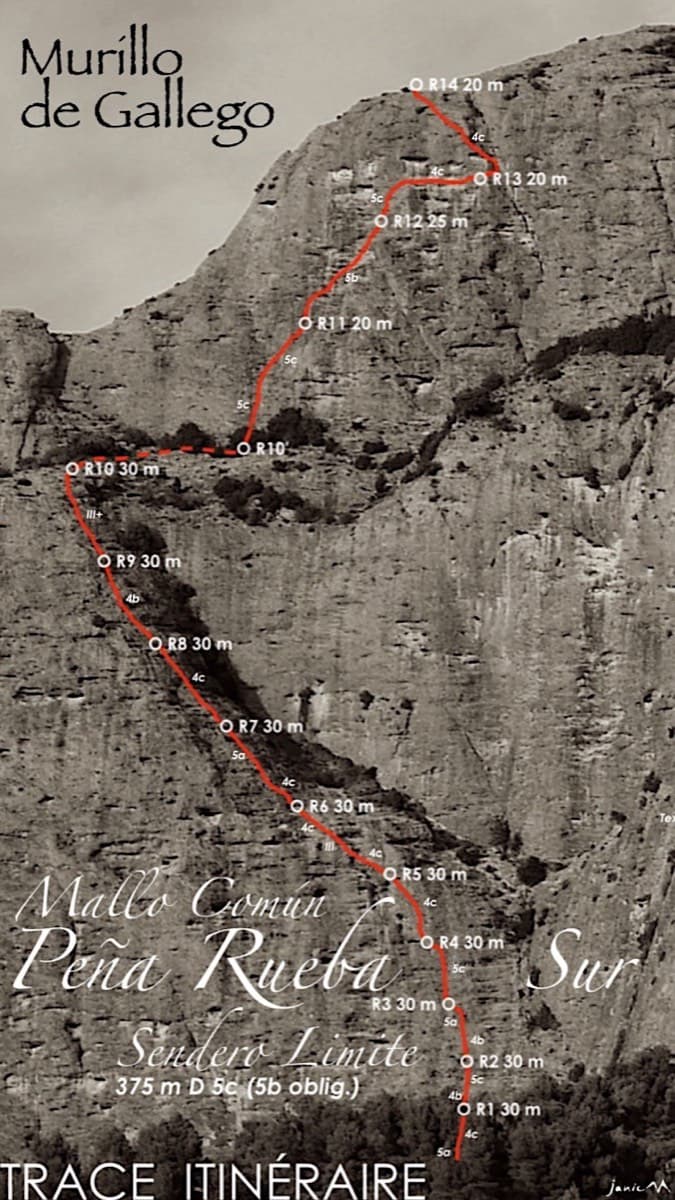
Topo of Sendero Límite on the south face of Peña Rueba (Mallo Común)

Spain · Riglos & Agüero (Mallos)

Sendero Límite

A long beginner's big route on good conglomerate at a moderate angle. Pitches can be linked in pairs with a 60 m rope. A four-pitch headwall with a couple of panzas finishes high above the Gállego valley.

5c14 pitches375 m

Topo of Tierra de Naide, Mallos de Agüero

Spain · Riglos & Agüero (Mallos)

Tierra de Naide

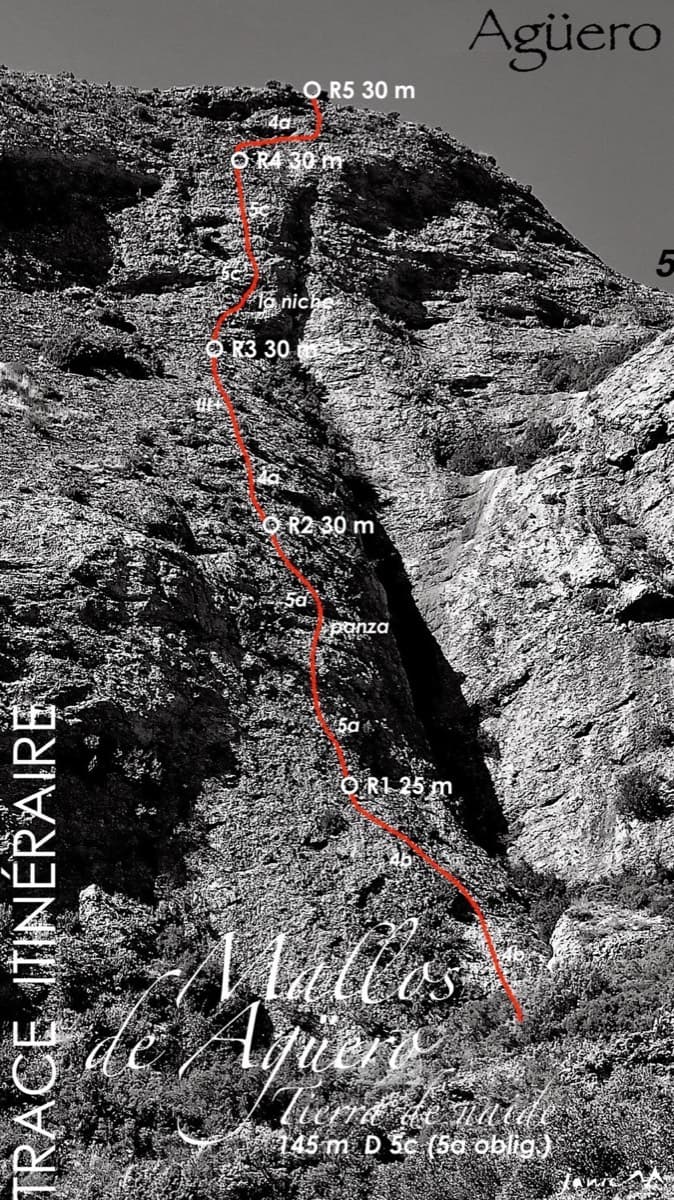
A morning-sun route at the quieter Agüero mallos. Easy slabs separate two fine steep walls, including a superb vertical 5c plaque on pitch 4. Take care with some loose cobbles on the last traverse.

5c5 pitches145 m

Around 5c · about 4 pitches

Similar elsewhere

Climber finishing the third pitch of Medo, Velika stena, Osp

Slovenia · Osp

Medo

The easiest line on Osp's famous overhanging Big Wall, following an obvious right-slanting ramp, the only non-overhanging part of the face. It is in shade until about 11:30 in July.

5c4 pitches110 m

Read the cautions

No photo yet

Morocco · Tafraout (Anti-Atlas)

The Silk Road

Bolted granite slabs to the top of a dome above the Tafraout valley, with a hand-traverse across a gully on pitch 3. Short, but a rest day from trad in an area that is otherwise almost all cams.

5c4 pitches95 m

The sea cliff of Montagna Spaccata seen from the beach at Gaeta

Italy · Gaeta & Sperlonga

Via dello Spigolo

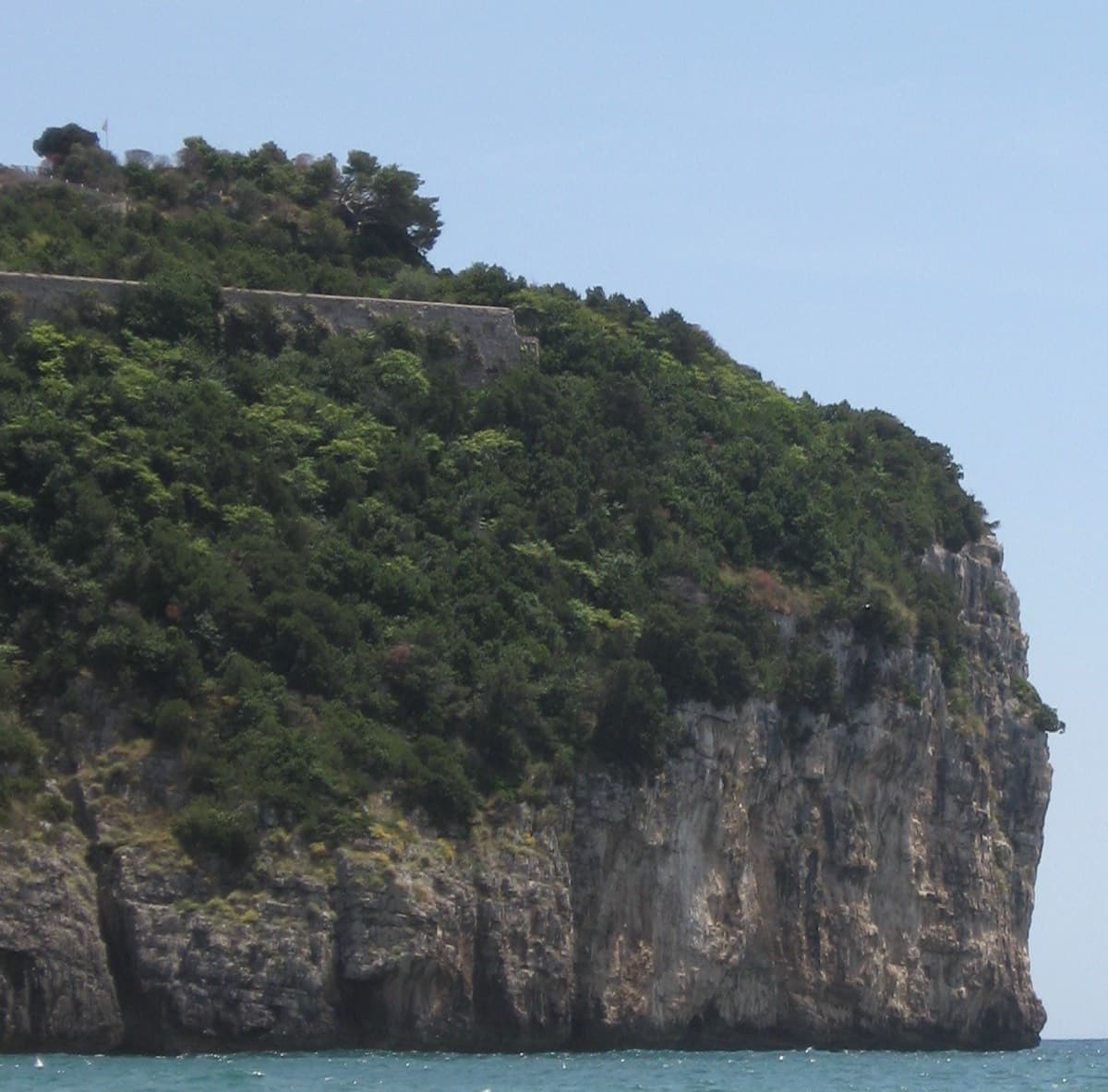
This was the second route on Montagna Spaccata and is the cliff's classic moderate. It's never hard but never trivial, with continuous exposure above the sea: a horizontal crack traverse, an athletic juggy chimney and corners. Gulliver gives UIAA grades V–V+ / IV+–V / V+ / V / V–IV+ (5c max), converted here.

5c5 pitches125 m

Read the cautionsCommitting

Gorra Frígia and Magdalena Superior, south-west faces, Montserrat

Spain · Montserrat

Via del Carles

A straightforward line up the 'Phrygian cap' visible from the monastery. Only the short vertical step on pitch 3 is sustained. It is a good route for learning Montserrat pebble technique and has a summit cross with a big view. The approach takes about 10 min from the Sant Joan funicular top.

5c5 pitches140 m

Compiled from published sources and last verified October 2026. Bolts, anchors and access change. Climbing is dangerous and you are responsible for your own decisions: check a current topo and read the disclaimer.