Multipitch Atlas

Monsieur

Los Calpes, Barranco de la Maimona · Montanejos · Spain

Bail with caveatsBolting confidence: high

Seven varied pitches in two halves split by a big ledge: vertical walls and cracks below, then an overhanging red wall and a traverse on a carpet of sharp little spikes beneath giant roofs. In the sun from the morning, unpolished, with an easy walk down.

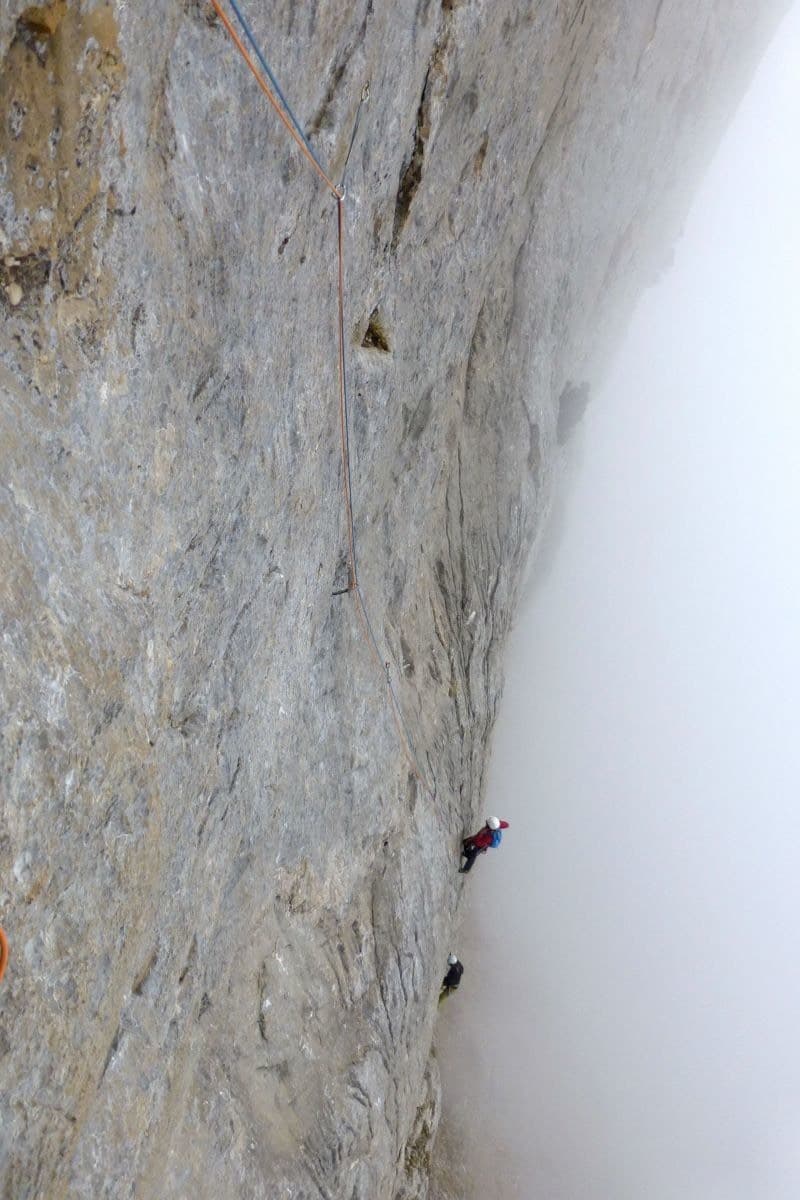
A leader on the first pitch of Monsieur at the Los Calpes sector, Montanejos.Photo: eusebio · CC BY-NC-ND 3.0

Photo

A leader on the first pitch of Monsieur at the Los Calpes sector, Montanejos.Photo: eusebio · CC BY-NC-ND 3.0
Hardest pitch
6b+
Pitches
7
Length
170 m
Approach
15 min
Aspect
S
South-facing
Rope
–

The route

Overview

A classic of the Maimona gorge that is easier to reach than the routes deeper in the canyon. Ascents are logged in February and April, which suggests it is outside the January to June closure that applies to the Espolón de los Agujeros; confirm locally. Three pitches of 5+ to 6a+ lead to a wide ledge that can be walked off; above, a 6b+ pitch on a steep red wall is followed by a striking easy crack and traverse and two more pitches to the top. The grades are even apart from the one harder pitch. Parties in 2022, 2025 and 2026 all rate it highly.

In pictures

Photos

Approach photo

The climbing

Pitch by pitch

Pitches of Monsieur
PitchGradeLengthNotes
P15+30 mA vertical wall on pockets and edges.
P26a+25 mVertical wall, then a crack.
P36a20 mVertical wall with short steps, arriving on the big ledge. Walk up the ledge; the route continues from stepped rock on the left, where one bolt and a ring are visible, below a rounded orange flake.
P46b+30 mAn overhanging red wall. A hard move in the opening traverse (take the lower crack, do not go high), easier climbing, then a very hard move under a big overhanging block: reach a large round hole on the right with a small fig tree growing in it, then go slightly left without getting under the overhang. The finish is easier but still pumpy. The hardest moves can be aided.
P55+20 mAn easy but very exposed crack, then a long traverse on tiny, extremely grippy spikes. The route page gives 5.
P65+15 mA corner and a small overhang. The route page gives 6a.
P76a30 mA technical vertical wall to the top.

Getting there

Approach

To the parking

Montanejos is in inland Castellón province, on the CV-20 road up the Mijares valley from Onda; no source read gives public transport details. The starting point is the climbers' refuge (Albergue El Refugio) at the mouth of the Maimona gorge, at the entrance to the village. Water is available from the village fountain or at the car park after the bridge.

On foot · about 15 min

About 15 minutes. From the refuge drop into the bed of the Barranco de la Maimona and walk up it easily. After about 10 minutes you pass below a fine red pillar, the Paredón del Alguacil; Los Calpes is the next sector. A cable, partly hidden by vegetation, helps you up a gully onto the big ledge at the foot of the routes. Go up left to the top of the cone. The start is a few metres left of the route RIO, whose name is engraved on the rock.

Finding the route · 1 photo

  • OverviewThe Barranco de la Maimona at Montanejos seen from above: the pale stream bed on the gorge floor is what you walk up to reach the climbing sectors. Los Calpes is about 15 minutes up it from the refuge.Photo: AngelVera81 · CC BY-SA 3.0

Approach photo

Map of the walk-in

  • Area: approximate

Loading map

The point is approximate: it marks the area, not the crag.

Coordinates · area: approximate

40.06100, -0.54000

Point from camptocamp waypoint 189249

For your phone or watch

Download GPX

Contains the route point. Opens in most mapping apps and GPS watches.

Points are compiled from published sources, with the precision stated above. They were not surveyed on the ground: check them against a current topo.

Getting down

Descent

Walk off. Follow the crest to the right to reach the waymarked path, which leads quickly and easily back to the road.

Retreat

Bailing off the route

Bail with caveats

The route is cut by a big ledge after pitch 3 that joins the GR path easily, which gives a walk-off escape at mid-height. Abseiling the route is not described by any source. Once on the upper half the easiest way out is to finish, pulling on bolts on pitch 4 if necessary.

Retreat from
The ledge at the top of pitch 3, on foot.
Point of no return
Starting pitch 4: it overhangs and begins with a traverse, and pitch 5 traverses again.
Carry
Nothing special for the ledge escape. For abseils from other belays take maillons, since the belay hardware is not described.
Basis
Stated in the sourcesThe ledge escape is stated on the camptocamp route page and in a 2025 trip report; nothing is published about abseiling.

Safety

Hazards

  • The second half runs beneath very large roofs and the 6b+ pitch is steep: a tired second will struggle to follow.
  • Finding the continuation after the ledge takes care: look for the single bolt and ring on the stepped rock to the left.
  • The Montanejos crag page warns that bolting in the area is sometimes spaced, although this route is reported as closely bolted where it is hard.
  • The canyon approach can be wet or flooded after heavy rain.

Sun and weather

Conditions

In the sun from the morning, and the lower half is sheltered from the wind, so it suits cold, clear days from autumn to spring. The rock is not polished. Ascents are logged in February, April and October.

Usual season · Jan to Apr, Oct to Dec

Sun on the wall · S-facing

Working out the sunlit hours for this month.

  • January (usual season): not yet worked out
  • February (usual season): not yet worked out
  • March (usual season): not yet worked out
  • April (usual season): not yet worked out
  • May: not yet worked out
  • June: not yet worked out
  • July: not yet worked out
  • August: not yet worked out
  • September: not yet worked out
  • October (usual season): not yet worked out
  • November (usual season): not yet worked out
  • December (usual season): not yet worked out

Sun on the wallDaylight, wall in shade● Usual season

Estimated from the wall's aspect only. Ignores surrounding terrain, gullies and the wall's exact shape. Clock times are local to the wall (Central European time), for the 15th of each month.

Monthly climate averages for Montanejos, 1991-2020
MeasureJan (usual season)Feb (usual season)Mar (usual season)Apr (usual season)MayJunJulAugSepOct (usual season)Nov (usual season)Dec (usual season)
Mean daily high °C111215182125292824201512
Mean daily low °C335710141718141164
Rain days 1 mm or more657997489866

● marks the usual climbing season. Averages for 1991-2020 at about 700 m. Area climate from Open-Meteo reanalysis. Temperatures are adjusted to the height of the crag; rain comes from a grid cell of about 10 to 25 km, and summer highs on sea cliffs can read a few degrees low. The wall and valley can differ. Data: Open-Meteo, CC BY 4.0.

What to carry

Gear

14 quickdraws plus belay kit (camptocamp). No rope length is stated; the longest pitch is 30 m and the descent is on foot. A 2022 party mentions one or two cams as optional. Helmet.

Checklist

Quickdraws
14
Rope
Length not given in the sources
Helmet
One each
Maillons or spare karabiners
To leave behind if you retreat

Derived from the route data; check it against a current topo

From climbers

Reader reports

Reader reports are not being collected yet. Until they are, check a current topo and the local club or guidebook publisher for recent changes to Monsieur.

Worth knowing

Tips

  • The big ledge after pitch 3 joins the GR path easily and is the escape if the upper half looks too hard.
  • Pitches 6 and 7 can be linked with a 50 m rope (2026 report).
  • It was crowded on an April 2026 weekend; go early.

Open questions

Where sources disagree

  • Length: camptocamp's header gives 250 m, but the pitch lengths in the April 2026 report add up to 170 m. The atlas uses 170 m.
  • Pitch grades: the route page gives 5+, 6a+, 6a, 6b+, 5, 6a, 6a; the 2026 report gives 5+, 6a+, 6a, 6b+, 5+, 5+, 6a.
  • Cams: a 2022 party mentions one or two as optional; the route page and the 2026 report list quickdraws only.
  • Only camptocamp could be read for this route, with three independent trip reports.

Provenance

Sources

Same area

More in Montanejos

All routes in Montanejos
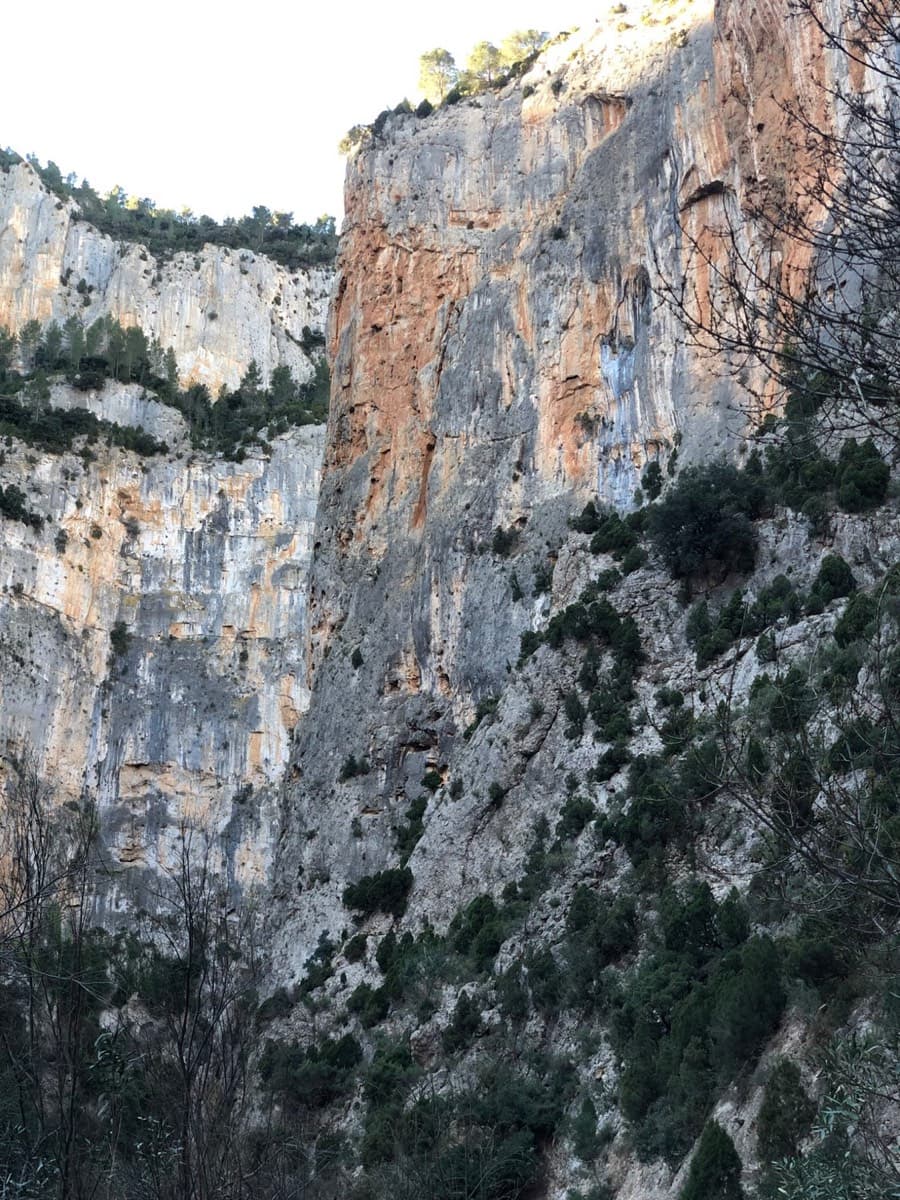
The walls of the Barranco de la Maimona at Montanejos, photographed on an ascent of La Luna.

Spain · Montanejos

La Luna

Eight pitches up a vertical prow deep in the Maimona canyon, on orange rock full of pockets (agujeros means holes). Sustained at 6a+ to 6b and physical throughout, with a huge roof start to the crux pitch and a bench to sit on at the third belay. Closed from January to June.

6b+8 pitches235 m

Read the cautions
Around 6b+ · about 7 pitches

Similar elsewhere

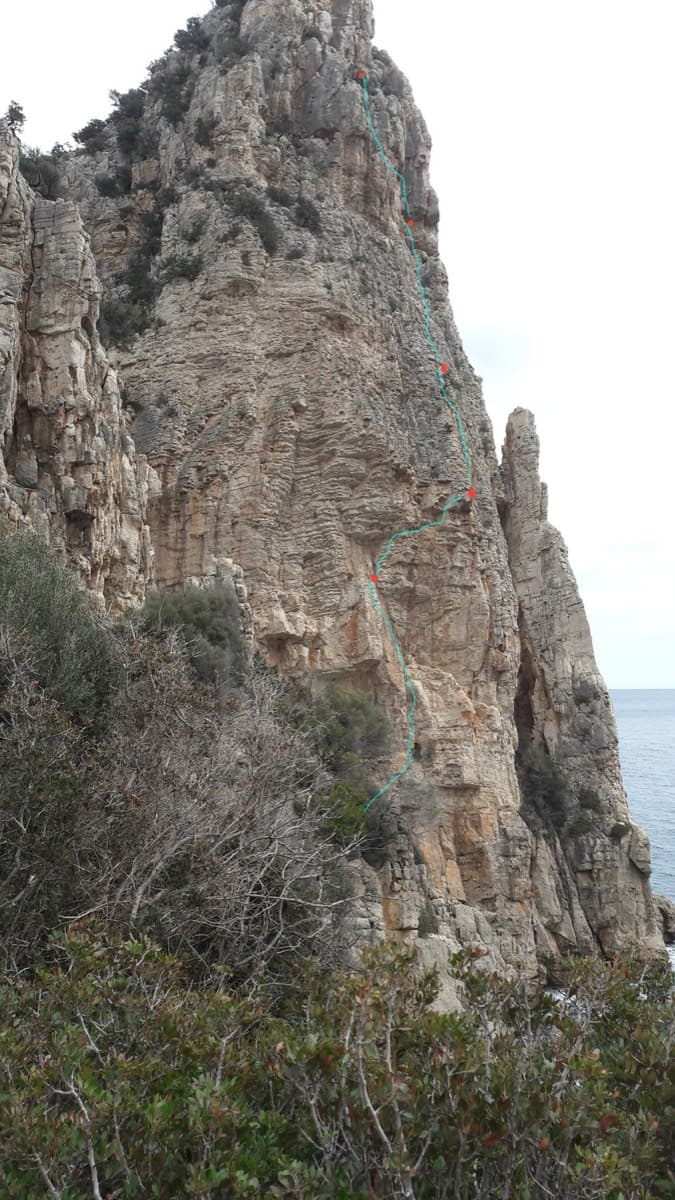
The south-east face of Pedra Longa with the line of Cromosomi Corsari and its belays marked

Italy · Sardinia

Cromosomi Corsari

A sea-level start reached by abseil, then seven short pitches up the seaward face of Pedra Longa. The third pitch is a wildly exposed traverse above a line of roofs; two easy pitches on rock that needs care lead to a technical 6b and 6b+ finish on grey slab.

6b+7 pitches175 m

Climbers on the grey limestone of Freedom, Karayalak Towers, as the morning mist clears

Turkey · Aladağlar

Freedom

Often named as the best route in the massif: seven even pitches of 6a to 6b+ that move from delicate slabs and giant flutings through a steep, rough wall to mountain-style ground at the top. The 6b pitches are no harder than the 6a ones, but the bolts are far enough apart to keep you thinking.

6b+7 pitches235 m

Read the cautions

No photo yet

Italy · Bolzano & South Tyrol

Il Cielo sopra Bolzano

Steep crack, corner and chimney climbing on porphyry, fully bolted in the middle of a trad crag. Sustained at 6a to 6b with a technical 6b+ first pitch. It stays in the shade until mid-afternoon, which makes it a summer option.

6b+7 pitches190 m

No photo yet

Spain · Riglos & Agüero (Mallos)

Irene y la Paz

A recent, closely bolted line on the Mallo Frechín and a good way to get to know Riglos without being frightened. A stiff 6b+ second pitch that many find nearer 6c, then steep, sustained 6a and 6a+ over a succession of bulges on unpolished rock. You can abseil off from the top.

6b+7 pitches190 m

Compiled from published sources and last verified October 2026. Bolts, anchors and access change. Climbing is dangerous and you are responsible for your own decisions: check a current topo and read the disclaimer.