Multipitch Atlas

Feu Sacré

Tour Termier – south-west face · Cerces · France

Bail with caveatsBolting confidence: medium

The classic hard route of the Tour Termier: ten steep, technical pitches on superb compact limestone at 3000 m, a short walk from the Col du Galibier road. It is never athletic but sustained at 6a+ to 6b, with a 7a pitch and a 6c move that both go at 6a A0. Cold, wind and thin footwork make it feel bigger than the numbers.

Photo-topo of Feu Sacré on the south-west face of the Tour TermierPhoto: dom · CC BY-NC-ND 3.0

Topo

Photo-topo of Feu Sacré on the south-west face of the Tour TermierPhoto: dom · CC BY-NC-ND 3.0
Hardest pitch
7a
Pitches
10
Length
320 m
Approach
60 min
Aspect
SW
South-west-facing
Rope
2×50 m

The route

Overview

Feu Sacré takes the south-west face of the Tour Termier (3070 m) left of the big central corner. The climbing is technical wall and slab work on water-pocketed, almost sharp limestone, including a magnificent red wall on pitch 6. Camptocamp grades the route ED-, and parties warn against judging it by the individual pitch grades: every pitch is steep, sustained and not obvious to read. The obligatory grade is 6b. An easier and popular outing combines pitches 1 to 5 with the upper pitches of the neighbouring Ponant Neuf.

The climbing

Pitch by pitch

Pitches of Feu Sacré
PitchGradeLengthNotes
P16a25 mStraight up a steep wall and out through a cracked corner. The Italian description takes the small corner on its left, not the wall on the right.
P26a+45 mA vertical corner and a wide crack; from its top climb easier rock trending well left to a small ledge. The easier part is sparsely bolted. The Italian description suggests skipping the first belay you reach and continuing left to a higher one.
P36a+35 mTraverse left, then straight up a technical slab to an abseil station, and continue 10 m left to belay on a ledge. Do not follow the bolts straight above the abseil station. The third belay of Ponant Neuf is 10 m further left on the same ledge.
P46b+25 mSlightly rightwards up the wall above the abseil station, with one delicate 6b+ move, then back left on a technical slab. Belay on the right. The Italian description treats this as the hardest free pitch, 6c+ or 6b and A0.
P56a20 mStraight up a technical wall on water-drop pockets to a ledge. The fourth belay of Ponant Neuf is just to the left; this is where the easier combination leaves.
P66b35 mStraight up, then trending left, on a magnificent red wall. Do not follow the bolt out left at the start.
P77a20 mA technical slab, then right into a delicate corner, which you leave for a flake leading to the belay. Goes at 6a with aid on the bolts.
P86b35 mTraverse left with one delicate move (a bolt for aid), then straight up a technical wall.
P96c45 mTwo technical walls of 6b to an optional belay at 25 m, then a small bulge with one move of 6c (6a with aid) and a very fine slab. The Italian description splits this pitch in two.
P105c35 mThe lying-back corner to the ridge, entering it from the right; belay on bolts a few metres below the true summit. You can also finish up the last corner of Ponant Neuf on the left.

Getting there

Approach

To the parking

From Briançon drive up the Guisane valley to the Col du Lautaret and take the Col du Galibier road. Park at the second hairpin before the memorial that stands just below the col, a left-hand hairpin with an unsurfaced parking area, level with a large electricity pylon away to the right. The Galibier road is closed by snow outside summer.

On foot · about 60 min

About 1 h. From the parking area take the path that traverses east towards the pylon, pass it and keep traversing, with some ups and downs, to the combe below the Tour Termier. Climb the combe and the scree to the foot of the face. The route starts left of the big whitish corner, about 50 m left of it according to the Italian description, below the corner of pitch 1; 'FEU' is scratched faintly on the rock. A 2026 party places it just right of a route with a small green cord.

Finding the route · 2 photos

Approach photo

Map of the walk-in

  • Crag
  • Parking
  • GPS line

Loading map

The point marks the crag, not the exact start of the route.

GPS line: one party's recorded GPS track of the walk-in. One party's recorded walk-in on 17 July 2026 from the hairpin parking below the Col du Galibier to the foot of the Tour Termier (one way). Do not follow it blindly.

GPS line: Carlos A, Alberto Calle · CC BY-NC-ND 3.0

Coordinates · crag

45.05927, 6.43720

Parking

45.06418, 6.40769

Col du Galibier (camptocamp access point)

Point from camptocamp waypoint 39495

For your phone or watch

Download GPX

Contains the route point, parking and a GPS line. Opens in most mapping apps and GPS watches.

Points are compiled from published sources, with the precision stated above. They were not surveyed on the ground: check them against a current topo.

Getting down

Descent

On foot, which camptocamp recommends: descend about 30 m on the far side over easy rock (grade II to III; a short abseil is possible), cross a plateau to the left facing in, and follow a track and cairns round to the Col Termier. Go down the steep gully on the far side of the col in zigzags, following traces, cairns and faded paint marks, then the scree back to the approach path. About 1 h 30 min to the car. Alternatively, seven abseils down the route: 35 m to belay 9; 45 m to belay 8, skipping the optional station; 45 m to belay 6; 30 m to belay 5; 45 m, skipping belays 4 and 3; 30 m from a station about 10 m right of and below belay 3; and 50 m from a station off the route to the left.

Retreat

Bailing off the route

Bail with caveats

The route has a documented abseil line of seven abseils, so retreat with two 50 m ropes is feasible from most of the way up. It is not a plain belay-to-belay descent: the line skips some belays and the two lowest stations are off the route, one about 10 m right of and below belay 3 and one to the left. From belay 5 you can also change to the easier Ponant Neuf to finish.

Retreat from
The abseil stations at belays 10, 9, 8, 6 and 5, then the two off-line stations below belay 3.
Point of no return
None stated. Pitches 3 and 8 traverse, so abseiling from belays that are not on the abseil line needs care.
Carry
2×50 m ropes; three of the abseils are 45 to 50 m.
Basis
Stated in the sourcesCamptocamp lists the seven abseils; the Italian description mentions the abseil descent without having checked it.

Safety

Hazards

  • Sustained climbing that is hard to read; several parties underestimate it from the pitch grades.
  • Bolts are well spaced on the easier ground, especially on pitch 2.
  • Cold and wind at 3000 m; numb fingers on the first four pitches are a common report.
  • Snow on the Col Termier descent early in the season; check before relying on the walk-off.
  • Route finding at the belays shared or adjacent with Ponant Neuf and at the abseil stations, some of which are off the line.

Sun and weather

Conditions

South-west facing between about 2800 and 3070 m. The wall is in shade and cold in the morning and gets the sun at about 11:00, so there is no point arriving too early. Wind from the Galibier is frequent and it can be cold even in midsummer. Reports run from mid June to mid September; in June the walk-off still held a lot of snow. The rock is very hard on the skin.

Usual season · Jul to Sep

Sun on the wall · SW-facing

Working out the sunlit hours for this month.

  • January: not yet worked out
  • February: not yet worked out
  • March: not yet worked out
  • April: not yet worked out
  • May: not yet worked out
  • June: not yet worked out
  • July (usual season): not yet worked out
  • August (usual season): not yet worked out
  • September (usual season): not yet worked out
  • October: not yet worked out
  • November: not yet worked out
  • December: not yet worked out

Sun on the wallDaylight, wall in shade● Usual season

Estimated from the wall's aspect only. Ignores surrounding terrain, gullies and the wall's exact shape. Clock times are local to the wall (Central European time), for the 15th of each month.

Climate figures for Cerces are not available yet

What to carry

Gear

Two 50 m ropes. 12 quickdraws if you stop at every belay; the Italian description takes 14. Cams are not needed, though both the Italian description and a 2026 party say a few small to medium ones could be placed on the easier, sparser sections. Warm clothes and a windproof. Helmet.

Checklist

Quickdraws
12
Rope
2×50 m
Helmet
One each
Abseil device and prusik
The descent or the retreat involves abseiling

Derived from the route data; check it against a current topo

From climbers

Reader reports

Reader reports are not being collected yet. Until they are, check a current topo and the local club or guidebook publisher for recent changes to Feu Sacré.

Worth knowing

Tips

  • Parties take 5 to 7 hours on the route.
  • Easier combination: Feu Sacré pitches 1 to 5, then pitches 5 to 9 of Ponant Neuf from the adjacent belay, starting with a traverse.
  • The route is popular in August; being first on it matters to some parties.
  • Take tape or skin care: the limestone is sharp.

Open questions

Where sources disagree

  • Pitch count and grades: camptocamp gives 10 pitches (6a, 6a+, 6a+, 6b+, 6a, 6b, 7a, 6b, 6c, 5c). The Scuola Guido della Torre description from 2018 gives 11, splitting the ninth, and grades pitch 4 at 6c+ or 6b A0 and pitch 6 at 6b+.
  • Length: camptocamp gives 270 m of height; its pitch lengths add up to 320 m; the Italian description says about 350 m of climbing. The sum of pitch lengths is used.
  • Quickdraws: 12 on camptocamp, 14 in the Italian description.
  • Equipment: 'close' according to a September 2026 party, 'spaced but well thought out' according to another the same month. The last full rebolt was in 1998.
  • The Cambon guide's sketch shows the last pitch shared with the right-hand exit of Ponant Neuf; camptocamp says the two are independent.

Provenance

Sources

Around 7a · about 10 pitches

Similar elsewhere

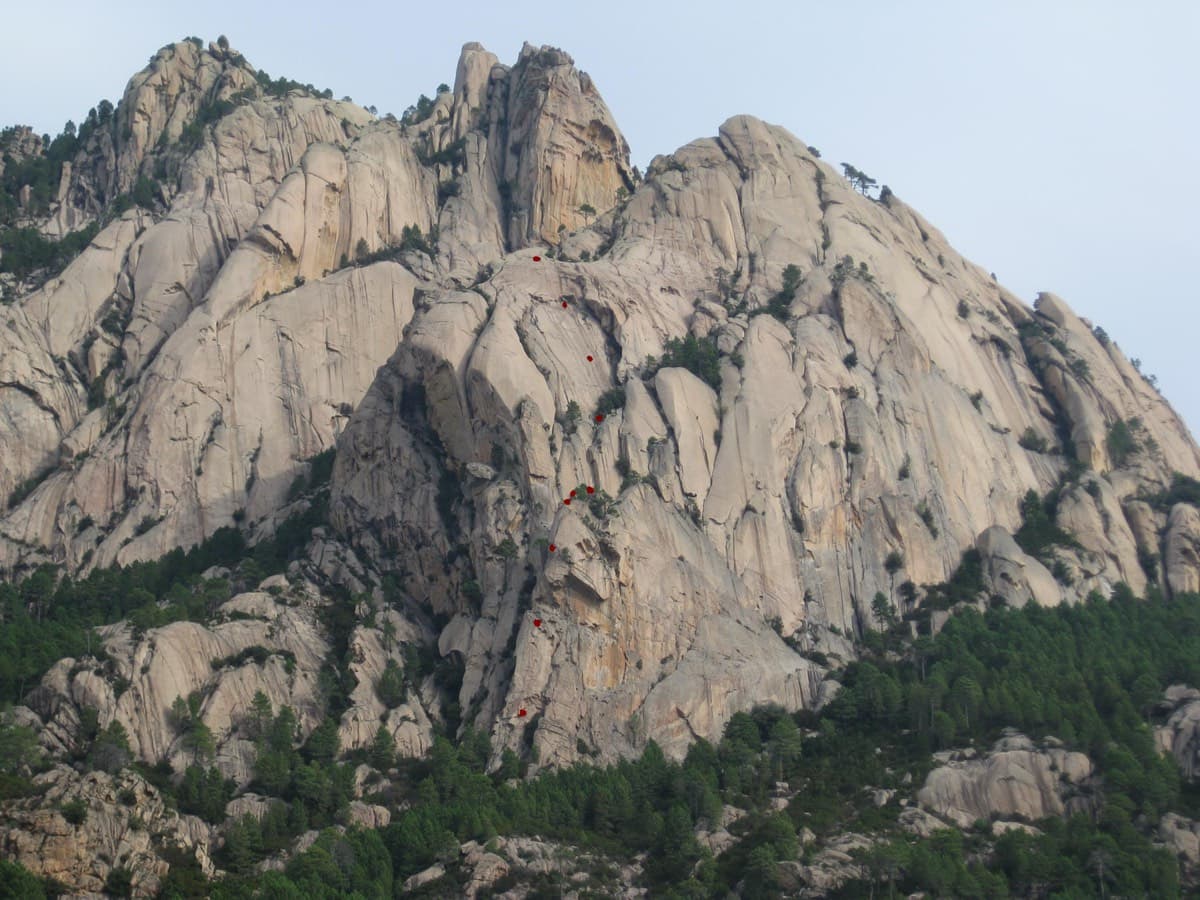
Teghie Lisce, Bavella, with the belays of Acqua in bocca marked in red

France · Bavella

Acqua in bocca

A sampler of everything Bavella granite does: a technical 7a wall, layback and jamming cracks, an off-width, a squeeze slot behind a tree, and three pitches of pure friction slab to finish. Bolted well enough to climb on quickdraws, which is rare here. The wide pitches are awkward and bruising if you are not used to the style.

7a10 pitches300 m

Read the cautions
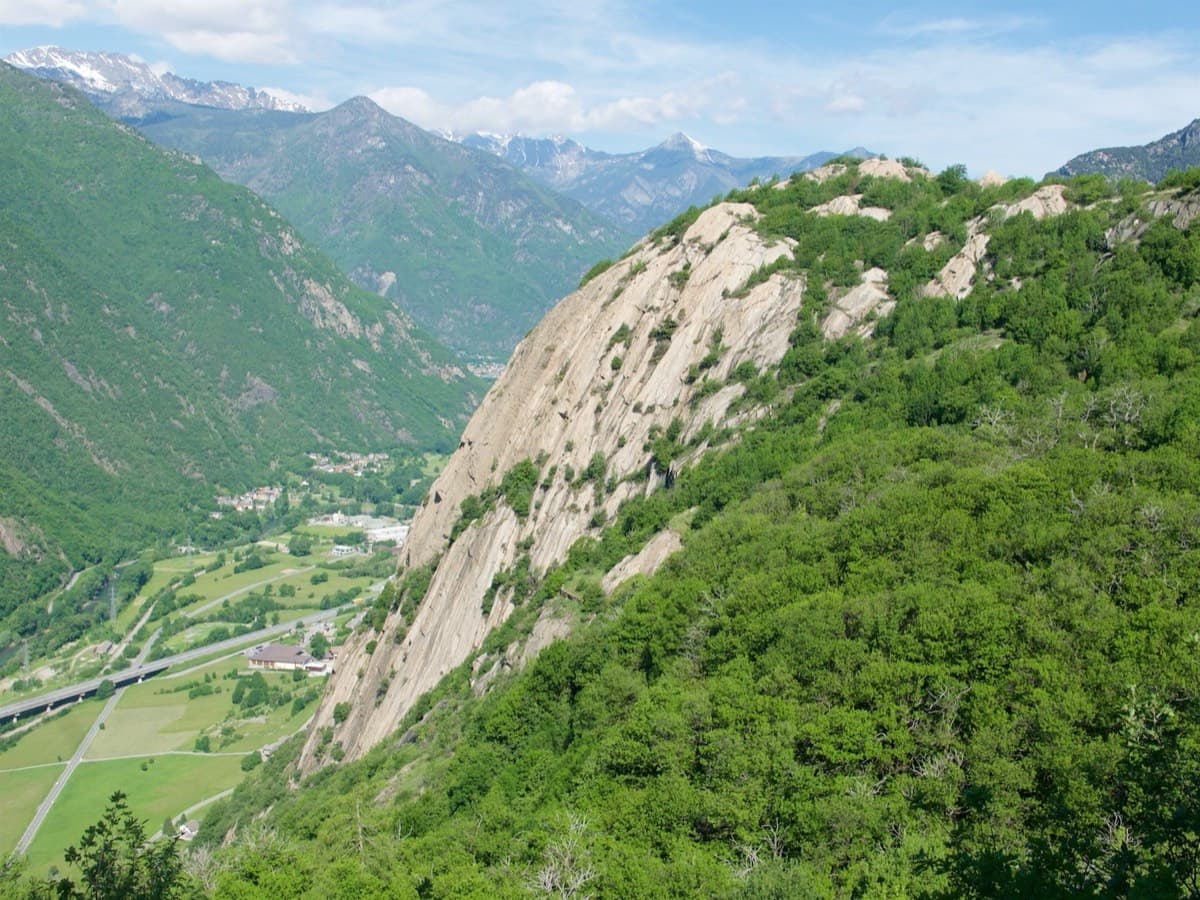
The Paretone di Arnad (Corma di Machaby) above the Dora Baltea valley, seen from the path to the Pilastro Lomasti

Italy · Aosta Valley

Sputnik

The hard route at the far left of the Paretone: two ordinary pitches, then steep walls on pitches 4 and 5 that are less slabby than the neighbours. Pitch 6 follows the arete at 7a, or 6a+ with a strenuous few metres of aid. Harder than the board at the car park suggests.

7a10 pitches250 m

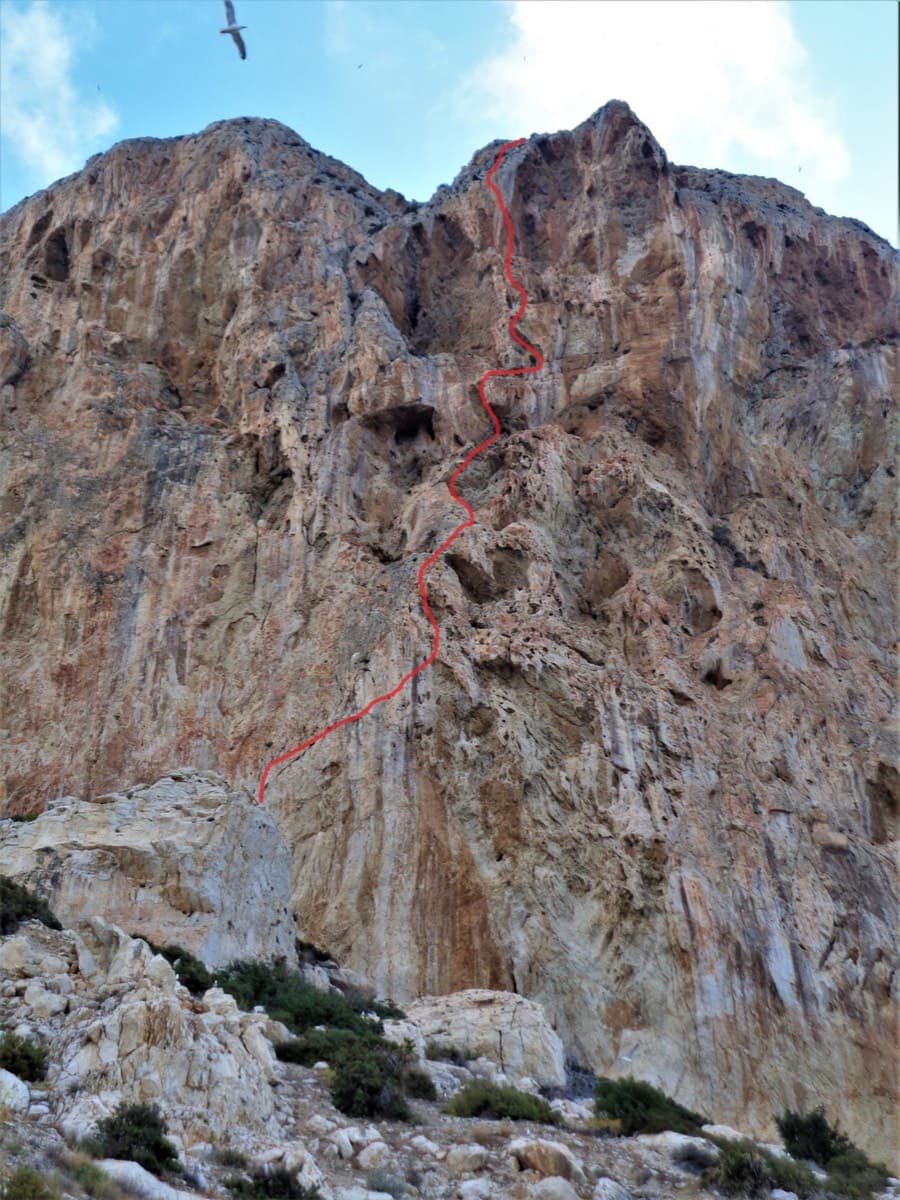
The line of Mare Nostrum on the south face of the Peñón de Ifach.

Spain · Costa Blanca (Peñón de Ifach)

Mare Nostrum

Nine steep pitches up the wildly sculpted right side of the south face, overhanging almost throughout. Two long 7a pitches open the route and a third comes near the top, and even the 6a+ pitches are athletic. The rock is covered in holds and much less polished than the classics to the left.

7a9 pitches310 m

Read the cautions

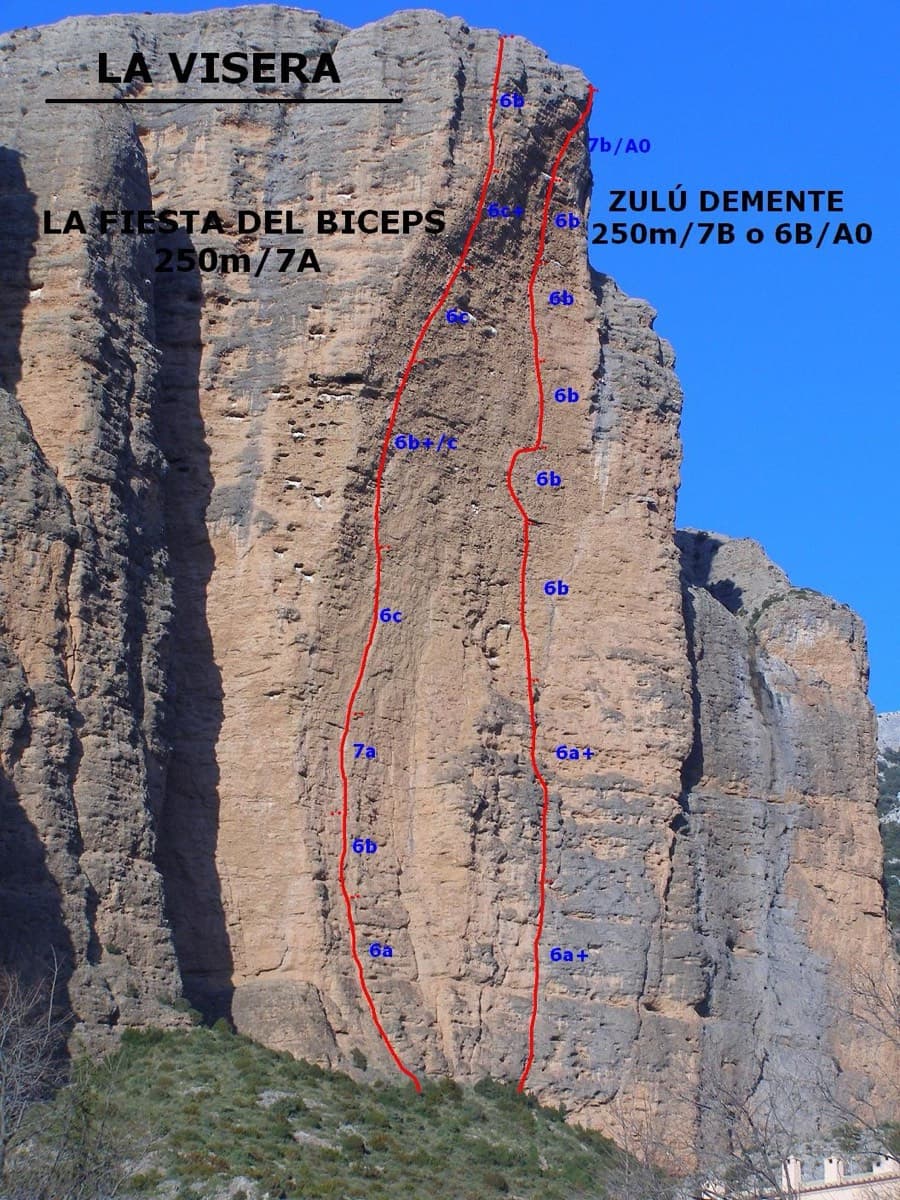
Photo-topo of La Visera at Riglos with La Fiesta de los Bíceps (left line) and Zulú Demente (right line)

Spain · Riglos & Agüero (Mallos)

La Fiesta de los Bíceps

The famous overhanging line up the left side of the Visera, following the white chalk stripe you can see from the village. A polished, technical 7a pitch low down, then five pitches of ever steeper climbing on huge cobbles where the difficulty is staying un-pumped. Bolts are sound but spaced, and above the third belay the only practical way off is the top.

7a8 pitches250 m

Read the cautionsCommitting

Compiled from published sources and last verified October 2026. Bolts, anchors and access change. Climbing is dangerous and you are responsible for your own decisions: check a current topo and read the disclaimer.