Multipitch Atlas

Costa Blanca

Peñón de Ifach, south face · Costa Blanca (Peñón de Ifach) · Spain

Bail with caveatsBolting confidence: high

The sport classic of the Peñón: a thin slab, a corner crack that steepens into an overhang, a pillar, then a wild exit from a big cave 200 m above the sea. Sustained at 6b with a 6c fifth pitch on polished slopers and a 6c+ last pitch whose crux can be pulled through on a bolt.

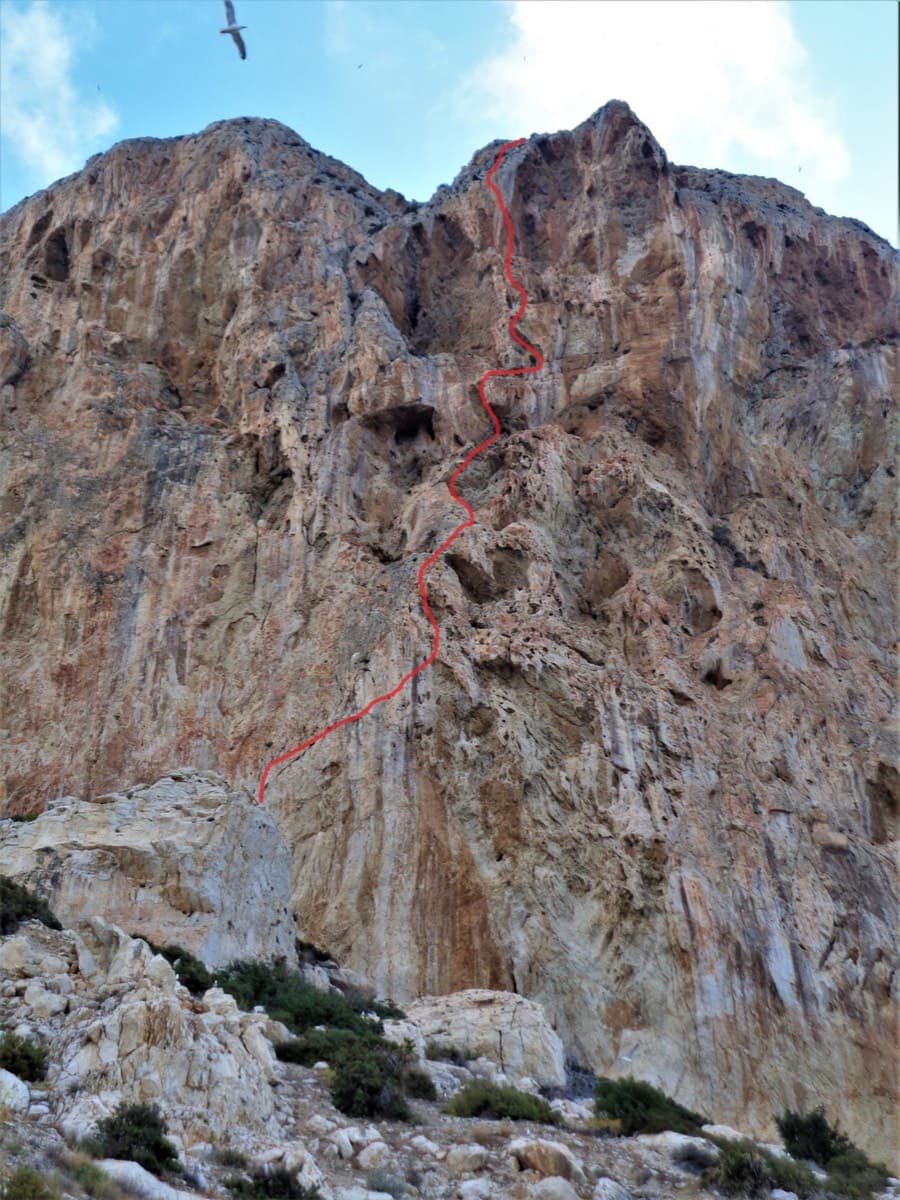
Photo-topo of Costa Blanca on the south face of the Peñón de Ifach, with belays R1 to R7 marked.Photo: Martin Gascuel · CC BY-SA 3.0

Topo

Photo-topo of Costa Blanca on the south face of the Peñón de Ifach, with belays R1 to R7 marked.Photo: Martin Gascuel · CC BY-SA 3.0
Hardest pitch
6c+
Pitches
7
Length
220 m
Approach
15 min
Aspect
S
South-facing
Rope
1×60 m
walk-off

The route

Overview

Opened from above in 1993 by Jaime Arviza and Salvador Guerola, this was the first route on the Peñón equipped in sport style and it is still the reference. It climbs the slim tower left of the Diedro UBSA, crosses a gully onto the wall behind and finishes through the big cave visible from the ground. Every pitch is good and the bolts are never far apart on the hard moves. The catch is traffic: the fifth pitch and parts of the second are polished, and the grades feel firm in warm, humid weather.

The climbing

Pitch by pitch

Pitches of Costa Blanca
PitchGradeLengthBoltsNotes
P1415 m1 boltsA short scramble up a vague corner, then right along a ledge to the first proper belay below a smooth slab. One bolt; a 2023 party describes 7 to 8 m of easy unprotected grade IV. Enlavertical gives III+.
P26b40 m–Thin, technical and slightly polished slab moves leftwards off the belay, which are the crux and easier taken on the left, then straight up the steep pillar. A fall from the first moves can land you back on the ledge, so the belayer must be alert. Enlavertical gives 6b+.
P36b35 m–Slab, a cracked corner that steepens, then a juggy overhang. It gets harder all the way to the belay. Take extendable quickdraws.
P46a35 m–Easier, well-featured climbing to a stance on the edge of the pinnacle. Enlavertical gives V+, a 2023 party 6a+. Climb right up to the platform and do not stop in the hollow, or the belayer cannot see the next pitch.
P56c32 m–Step down and across the gully onto the wall behind; the first bolt is high. Pull over a small overhang, then a sustained wall with a traverse on polished, sloping holds, with the crux level with a bolt. Some sources give 6b+.
P66b30 m–A small overhang straight off the belay, athletic and started on an undercut tufa, then nothing hard to the big cave. The belay is inside the large hole, slightly right, not above it. Rockfax gives 20 m.
P76c+35 m–Out of the cave by the left on steep jugs and a pocketed slab (6b), an easy ramp right (V+), then an overhanging exit leftwards on sloping holds. The crux is short and goes at 6b with a pull on a bolt. An easy unbolted scramble follows to the summit, where a spike or a further belay can be used.

Getting there

Approach

To the parking

Calp is on the N-332; from the AP-7 take exit 64 (Altea/Calp) and follow the N-332 towards Calp. For the south face follow signs to the harbour (Puerto) and park there. The provincial guide gives the harbour-side parking as 38°38'16"N, 0°04'19"E.

On foot · about 15 min

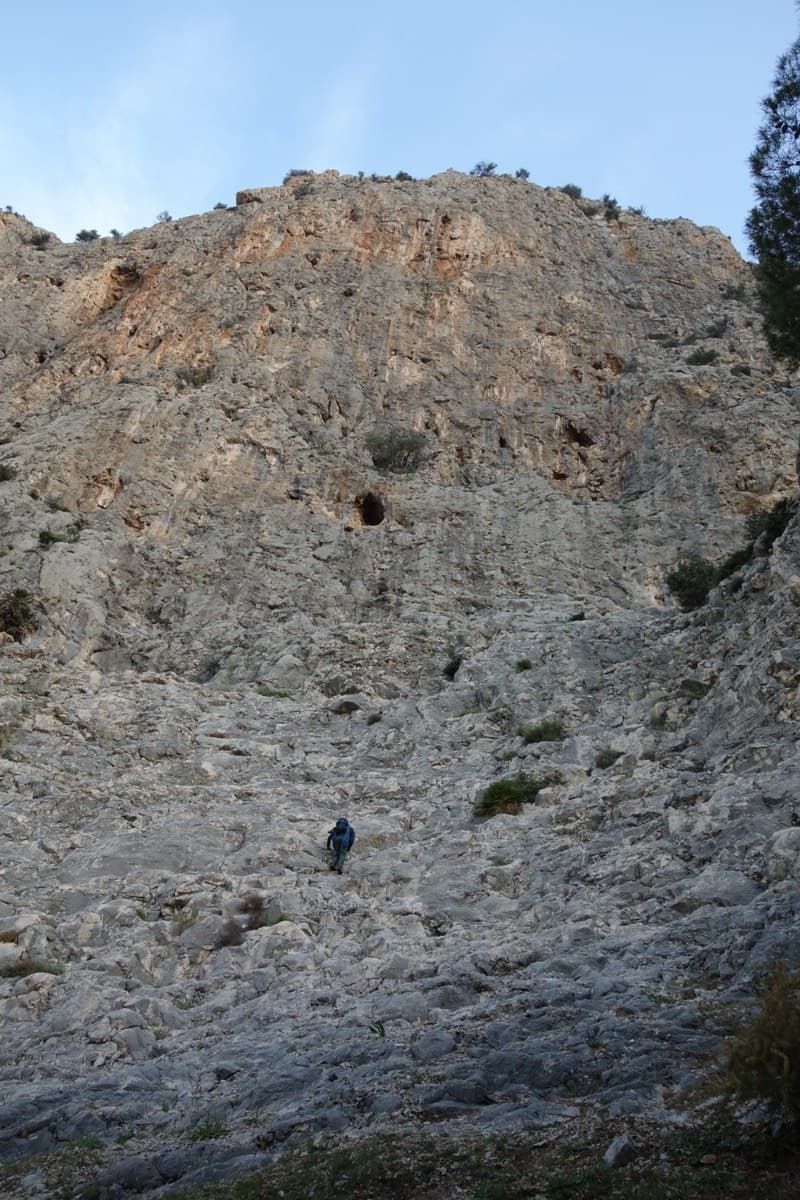
10 to 20 minutes. Walk to the end of the seafront promenade (Paseo Príncipe de Asturias) that runs below the rock, then take the steep path that starts against the cliff and doubles back up under the south face. Start at the flat area below the Vía Valencianos. Take approach shoes for the walk in and the walk down.

Finding the route · 1 photo

Approach photo

Map of the walk-in

  • Crag
  • Parking

Loading map

The point marks the crag, not the exact start of the route.

Coordinates · crag

38.63389, 0.07611

Parking

38.63778, 0.07194

Harbour-side parking for the south face (Senderos de la Roca guide)

Point from camptocamp waypoint 249782

For your phone or watch

Download GPX

Contains the route point and parking. Opens in most mapping apps and GPS watches.

Points are compiled from published sources, with the precision stated above. They were not surveyed on the ground: check them against a current topo.

Getting down

Descent

Walk off by the summit footpath: it zigzags down the back, passes through a short tunnel to the north side and continues, waymarked, to the visitor centre. Several parties warn that the path is very polished. UKC notes that the park asks walkers to register to use the summit path.

Retreat

Bailing off the route

Bail with caveats

Belays have two or three bolts and a 2022 UKC comment says the route is well equipped and would be easy to bail from, or to aid on the harder sections. Nobody documents an actual retreat. Pitches are 30 to 40 m, so abseiling needs two ropes, and above pitch 4 you would first have to reverse the step across the gully.

Retreat from
Belays 1 to 4 on the tower are in a fairly direct line. From the belays above the gully a retreat means regaining the pinnacle side or abseiling the wall behind, which is not described.
Point of no return
Crossing the gully at the start of pitch 5. From the cave, the bolted 6a+ link to Los Miserables or pulling on bolts on the last pitch are the practical ways out.
Carry
Two 50 m ropes if you want the option; with the usual single rope you cannot abseil the 35 to 40 m pitches. Maillons in case the belays have no rings.
Basis
Part stated, part inferredBolted belays and the 'easy to bail' remark are stated (enlavertical, UKC 2022); the rope requirement and the gully problem are inferred from the pitch descriptions.

Partly inferred from the route facts

Safety

Hazards

  • The start of pitch 5 involves stepping down and across a gully with the first bolt high. Parties disagree on whether to belay at the fixed belay or on the ledge behind; both have drawbacks, so protect the second and the leader as best you can.
  • Polish: pitch 5 and the first moves of pitch 2 are worn.
  • A fall from the first moves of pitch 2 can reach the belay ledge.
  • Some bolts were reported rusty at the starts of pitches 5 and 6 in 2014, and loose nuts were noted in 2026. Check what you clip.
  • The pitch 6 belay is easy to miss: it is inside the big hole, slightly right.
  • Seagulls nest on the face and the descent path is very polished.
  • Climbing is normally banned from 1 April to 30 June for nesting birds.

Sun and weather

Conditions

South-facing. In November the sun reached the wall at about 11:00. Winter is best: a February party found the holds greasy and the grades hard in the heat, and December ascents were climbed hot in full sun. The Peñón can be humid and slippery when the wind is from the east.

Usual season · Jan to Mar, Oct to Dec

Sun on the wall · S-facing

Working out the sunlit hours for this month.

  • January (usual season): not yet worked out
  • February (usual season): not yet worked out
  • March (usual season): not yet worked out
  • April: not yet worked out
  • May: not yet worked out
  • June: not yet worked out
  • July: not yet worked out
  • August: not yet worked out
  • September: not yet worked out
  • October (usual season): not yet worked out
  • November (usual season): not yet worked out
  • December (usual season): not yet worked out

Sun on the wallDaylight, wall in shade● Usual season

Estimated from the wall's aspect only. Ignores surrounding terrain, gullies and the wall's exact shape. Clock times are local to the wall (Central European time), for the 15th of each month.

Climate figures for Costa Blanca (Peñón de Ifach) are not available yet

What to carry

Gear

16 quickdraws, several of them extendable, and slings and karabiners for belays on bolts (enlavertical, and a 2023 party). A single rope is enough because you walk down; Rockfax suggests twin 50 m ropes on the south face in case you need to abseil. A sling is useful for the summit belay. A 2015 party protected the step across at the start of pitch 5 with a cam.

Checklist

Quickdraws
16
Rope
1×60 m (walk-off)
Helmet
One each
Maillons or spare karabiners
To leave behind if you retreat

Derived from the route data; check it against a current topo

From climbers

Reader reports

Reader reports are not being collected yet. Until they are, check a current topo and the local club or guidebook publisher for recent changes to Costa Blanca.

Worth knowing

Tips

  • Allow 4 to 6 hours; fast parties take 3.5 to 4.5 hours.
  • If the last pitch is too much, a 15 m bolted 6a+ leaves the pitch 5 belay leftwards to join the top pitch of Los Miserables, which climbs a cave on huge holds at about 6b. An older description of that exit mentions doubtful, unequipped rock on the direct line from the ledge, so take the bolted link.
  • The pinnacle to the cave (pitches 5 and 6) has been linked on a 50 m rope.
  • Carry a small adjustable spanner for the second to nip up any spinning hangers (2026 suggestion).

Open questions

Where sources disagree

  • Length: 250 m in the provincial guide and enlavertical, 220 m on camptocamp, 207 m in Rockfax. Camptocamp is used.
  • Pitch grades: camptocamp and Rockfax give -, 6b, 6b, 6a, 6c, 6b, 6c+; enlavertical gives III+, 6b+, 6b, V+, 6b+, 6a+, 6c+; UKC users suggest 6b+ or 6c for pitch 5.
  • Pitch 6 length: 30 m on camptocamp, 20 m in Rockfax and enlavertical.
  • Equipment: enlavertical (2009) says fully equipped with parabolts; a 2014 report found some badly rusted bolts; reports from 2015, 2022 and 2023 call it well or very well equipped.
  • Where to belay before pitch 5: the camptocamp description recommends a spike on the ledge behind; one 2015 party and a 2024 party advise against it, while another 2015 party and a 2023 party did belay on the ledge.

Provenance

Sources

Same area

More in Costa Blanca (Peñón de Ifach)

All routes in Costa Blanca (Peñón de Ifach)
The line of Mare Nostrum on the south face of the Peñón de Ifach.

Spain · Costa Blanca (Peñón de Ifach)

Mare Nostrum

Nine steep pitches up the wildly sculpted right side of the south face, overhanging almost throughout. Two long 7a pitches open the route and a third comes near the top, and even the 6a+ pitches are athletic. The rock is covered in holds and much less polished than the classics to the left.

7a9 pitches310 m

Read the cautions
Around 6c+ · about 7 pitches

Similar elsewhere

Pitch 4 (6a+) of Dans les Yeux d'Hervé: compact grey Verdon limestone

France · Verdon

Dans les Yeux d'Hervé

Seven pitches of compact grey water-pocketed wall high above the mouth of the Verdon gorge, with a view over the Lac de Sainte-Croix. It zigzags a great deal, so both leader and second need to be happy on traverses. A short, bouldery 6c+ bulge (6a/A0) is the only move above 6b+, and the final pillar pitch is the highlight.

6c+7 pitches160 m

Committing

The stepped slabs you scramble up to reach the start ledge of El Corazón que no Siente on the Frontales wall.

Spain · El Chorro

El Corazón que no Siente

Four pitches in a row at 6b+ to 6c+ on extremely rough limestone: technical water-pocket moves that are hard to read, then an athletic pitch up easy tufas to a hard pull over an overhang. Quiet and steep, with 6b+ obligatory.

6c+7 pitches200 m

No photo yet

Croatia · Paklenica

Big Wall Speed Climbing (Tinin raz)

The line used for Paklenica's annual Big Wall Speed Climbing competition: steep, direct and on very rough rock that has stayed unpolished. A sustained 45 m 6c+ pitch on small holds is the crux, followed by sharp runnels, a big corner and three overhangs to finish. Fifteen minutes from the car.

6c+6 pitches200 m

No photo yet

Italy · Arco & Valle del Sarca

Via Roberto

Eight sustained pitches up the wall opposite the Laterna restaurant, rarely easier than 6a. The crux is a short overhanging wall on pitch 5 that can be pulled through on the bolts. Less cleaned than its neighbours, with some broken rock on pitch 6.

6c+8 pitches220 m

Compiled from published sources and last verified October 2026. Bolts, anchors and access change. Climbing is dangerous and you are responsible for your own decisions: check a current topo and read the disclaimer.